Material study
8 September 2026
6 min read
Gold ground: light in a Sienese panel
Duccio’s small Madonna and Child is built from wood, gesso, gold leaf and egg. Each material governs how the picture handles light.
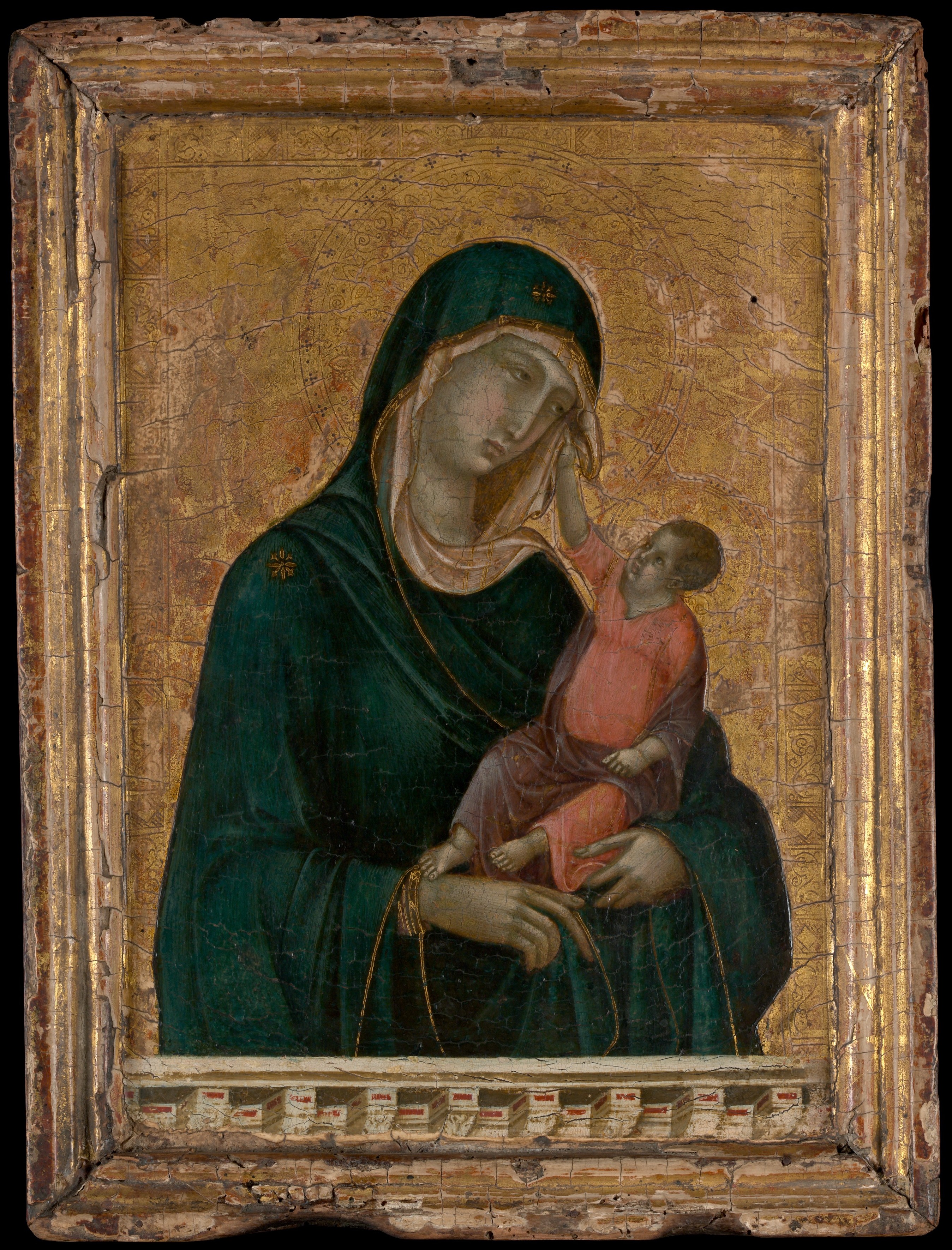
Duccio’s Madonna and Child with a tooled gold ground and painted parapet
Why the ground is gold
The panel painting of thirteenth- and fourteenth-century Italy kept a convention inherited from Byzantine icons: the figures stand against a field of gold rather than a landscape or a room. Gold is not a colour in the ordinary sense. It reflects rather than absorbs, so a gold ground changes with the position of the viewer and the source of light. In a chapel lit by candles the effect was of figures floating in a warm, shifting brightness. The Met notes that the lower edge of the original frame of Duccio’s Madonna and Child is marked by candle burns, which is as direct a record of that lighting as one could hope to find.
Gold also carried meaning. It was costly, it did not tarnish, and it stood for a light that was not of this world. The painter’s task was to make figures that could hold their own against it. Duccio’s answer, in this small panel painted around 1290 to 1300, was to use the gold as a backdrop for a very human exchange: the Child reaching up to push aside his mother’s veil, and the mother looking past him with an expression the museum reads as foreknowledge of his death.
How the surface was built
The process began with a wooden panel, usually poplar, covered with cloth and then with layers of gesso, a mixture of gypsum and animal glue, scraped and sanded until it was smooth as ivory. The design was drawn and incised into this white surface. Where gold was to go, the painter brushed on bole, a fine red clay that gives the leaf a warm undertone and a bed soft enough to burnish. Gold leaf, beaten thinner than paper, was laid onto the dampened bole and then rubbed with a polished stone until it shone.
Only then did the painter turn to colour. Egg tempera, pigment bound in egg yolk, dries quickly and cannot be blended on the panel like oil, so the flesh was built up in small hatched strokes over a green underlayer, which is why the shadows on many early Italian faces still have a greenish cast. The haloes were tooled into the gold with punches and a stylus, so that their patterns catch light differently from the flat ground around them. Every stage was governed by the behaviour of a material, and the finished picture is a record of those constraints as much as of an idea.
The parapet and the edge
Across the bottom of Duccio’s panel runs a painted parapet, a low ledge in front of the figures. It is a small thing, but it does something the gold ground cannot: it places the Virgin and Child in a space continuous with the viewer’s own, as if they stood at a window. The Met describes this as connecting the sacred world of the painting with the temporal one of the viewer, and it is among the earliest examples of the device in Italian art.
Look, then, at the edge where the parapet meets the frame, and at the frame itself, which is engaged, meaning it was carved as part of the panel rather than added later. The candle burns are there. This is a painting that was used, in the sense that prayers were said in front of it and lights were left burning beneath it, for long enough to scorch the wood. The gold, the tempera and the burns belong to the same object, and together they describe how light was understood to work in a small Sienese panel.