An illustrated guide · 12 histories
300 – 1520
Medieval art
through time.
Different places. Overlapping histories. A shared question: what can gold, glass, ink and stone be made to hold?
Travel through objects, workshops, beliefs, and ways of seeing. These chapters offer points of entry, not a complete history or a single line of progress.
Explore the timelineRead across time
Many histories, at once.
Each bar marks a chapter’s approximate focus. Overlap means these histories share time, not that one caused another. Select a chapter to begin.
All 12 chapters
Bars use a linear year scale. Dates are approximate; chapter boundaries are editorial guides, not universal period divisions.
c. 300–600
Late Antique & Early Christian
The Roman Mediterranean
c. 500–1453
Byzantium
Constantinople and the eastern Mediterranean
c. 600–900
Insular art
Britain and Ireland

c. 750–900
Carolingian renewal
Francia, centred on Aachen
c. 950–1050
Ottonian splendour
The German lands and northern Italy
c. 1000–1200
Romanesque
Western Europe

c. 900–1300
Crossroads: Iberia, Sicily & the Crusader east
The Mediterranean frontiers
c. 1140–1300
The Gothic cathedral
Northern France and beyond
c. 1150–1450
The illuminated page
Paris and the courts of France
c. 1250–1400
Courtly ivories & the treasury
Paris and the church treasuries of Europe
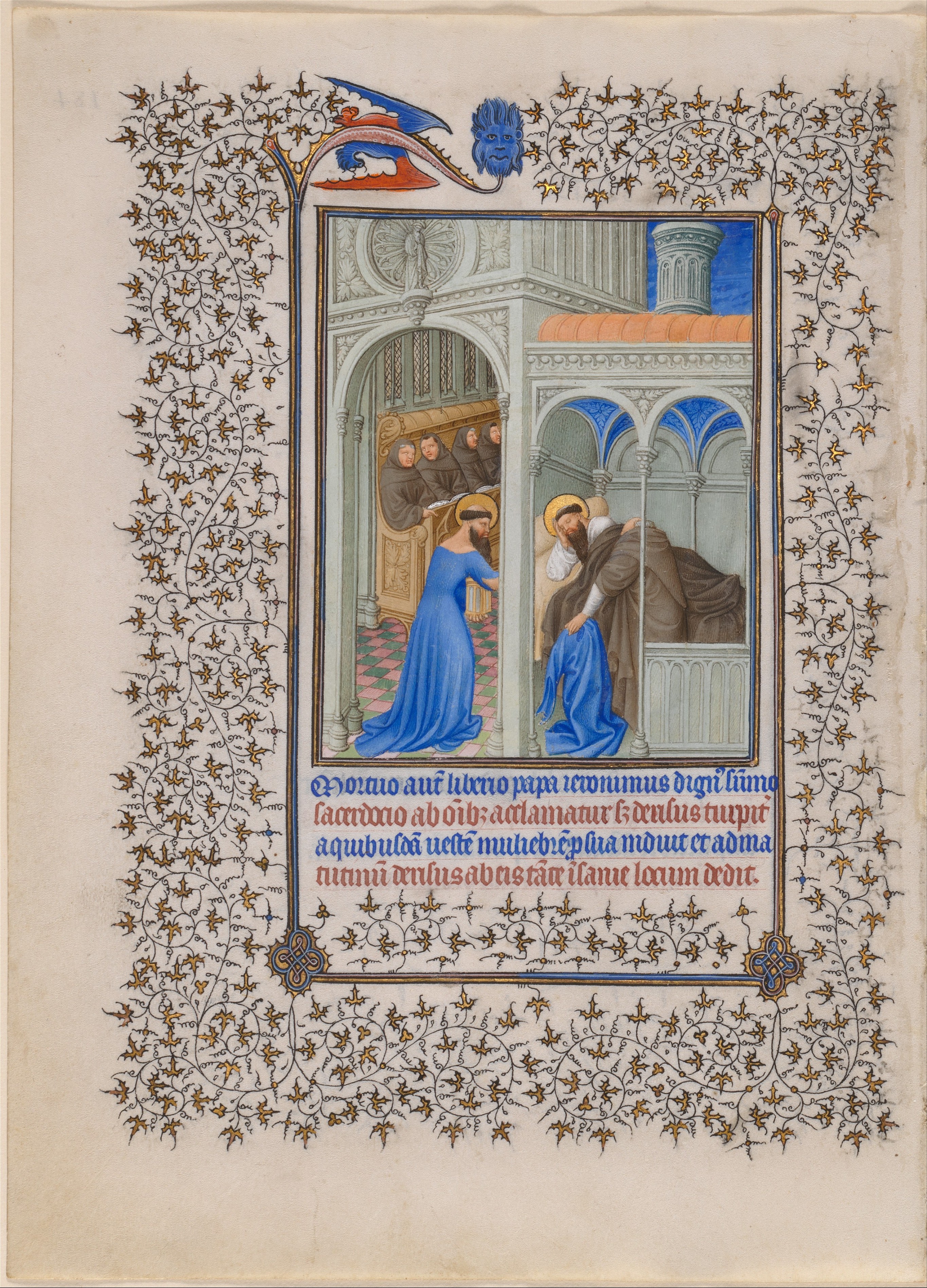
c. 1380–1450
International Gothic & the Burgundian court
Paris, Dijon and the princely courts
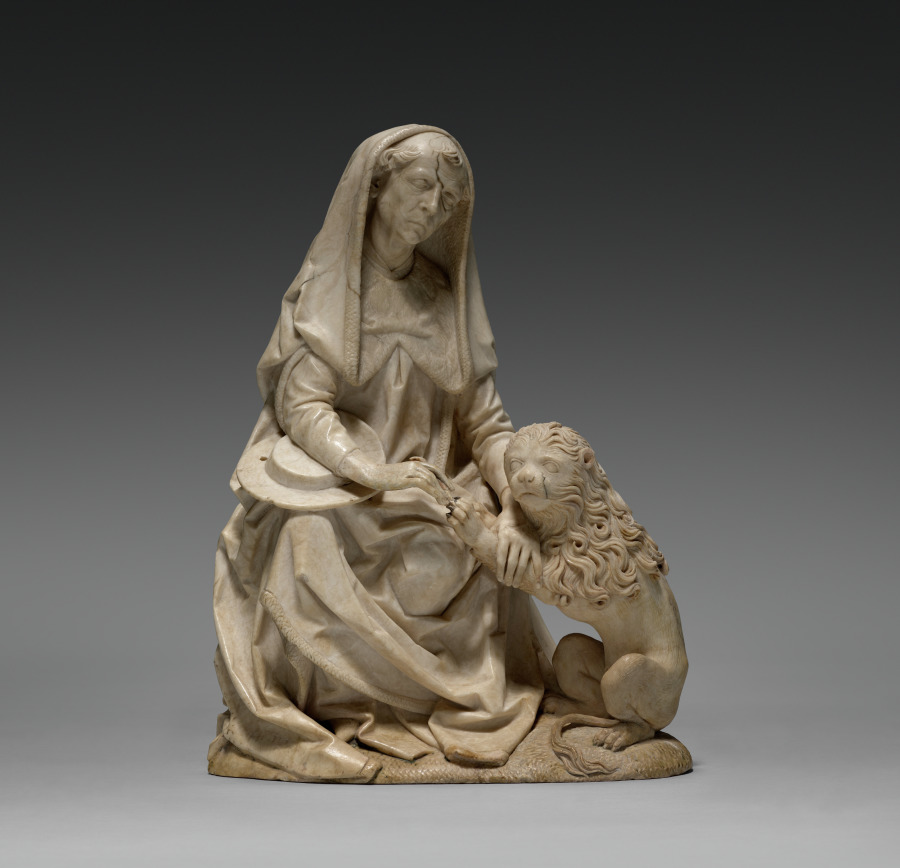
c. 1400–1520
Late Gothic: altarpieces & the printed image
Germany, the Netherlands and France
The Roman Mediterranean
01 of 12
Late Antique & Early Christian
c. 300–600
early 300s · Marble, white
The Metropolitan Museum of Art · Gift of John Todd Edgar, 1877
Old forms, a new story.
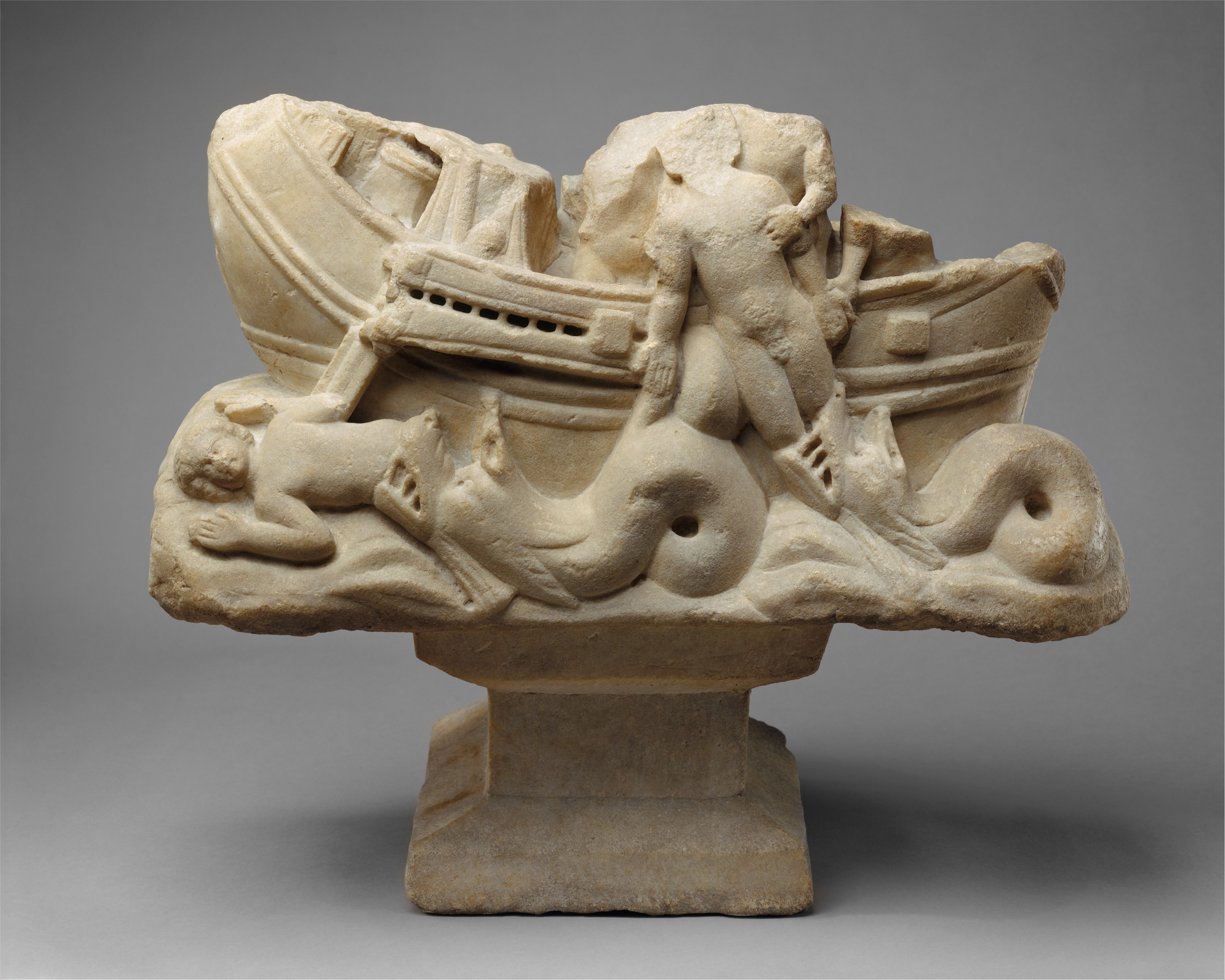
The first Christian art did not invent a new visual language. It borrowed the figures, ornament and objects of the Roman world and gave them other things to say. A sea monster from classical myth could swallow Jonah; a shepherd carrying a lamb could become Christ.
This marble table base, carved in Asia Minor in the early fourth century, shows Jonah swallowed by a ketos and then cast up on the shore. The Gospel of Matthew presents the story as a foretelling of the Resurrection, and it was among the most common subjects in early Christian tomb art. The base was found at Tarsus, the birthplace of Saint Paul. Domestic and funerary objects like this, rather than large churches, carry much of what survives from the decades around Constantine’s legalisation of Christianity in 313.
Three ways to look
- 1Find the ship: the Met notes it is a rare detailed image of a Roman merchant vessel.
- 2Compare the classical monster with the prophet it swallows. Which parts of the carving would a non-Christian viewer have recognised?
- 3Ask what the object was for. A table support is furniture; its decoration was seen at close range and from above.
Sources & further reading · 2
Constantinople and the eastern Mediterranean
02 of 12
Byzantium
c. 500–1453
late 900s · Elephant ivory
The Metropolitan Museum of Art · Gift of J. Pierpont Morgan, 1917
The image as a door to the holy.
For nearly a thousand years the empire ruled from Constantinople produced icons, ivories, enamels and mosaics for the Orthodox liturgy and the imperial court. After the disputes over images in the eighth and ninth centuries, the icon became central to devotion, and its conventions changed slowly and deliberately.
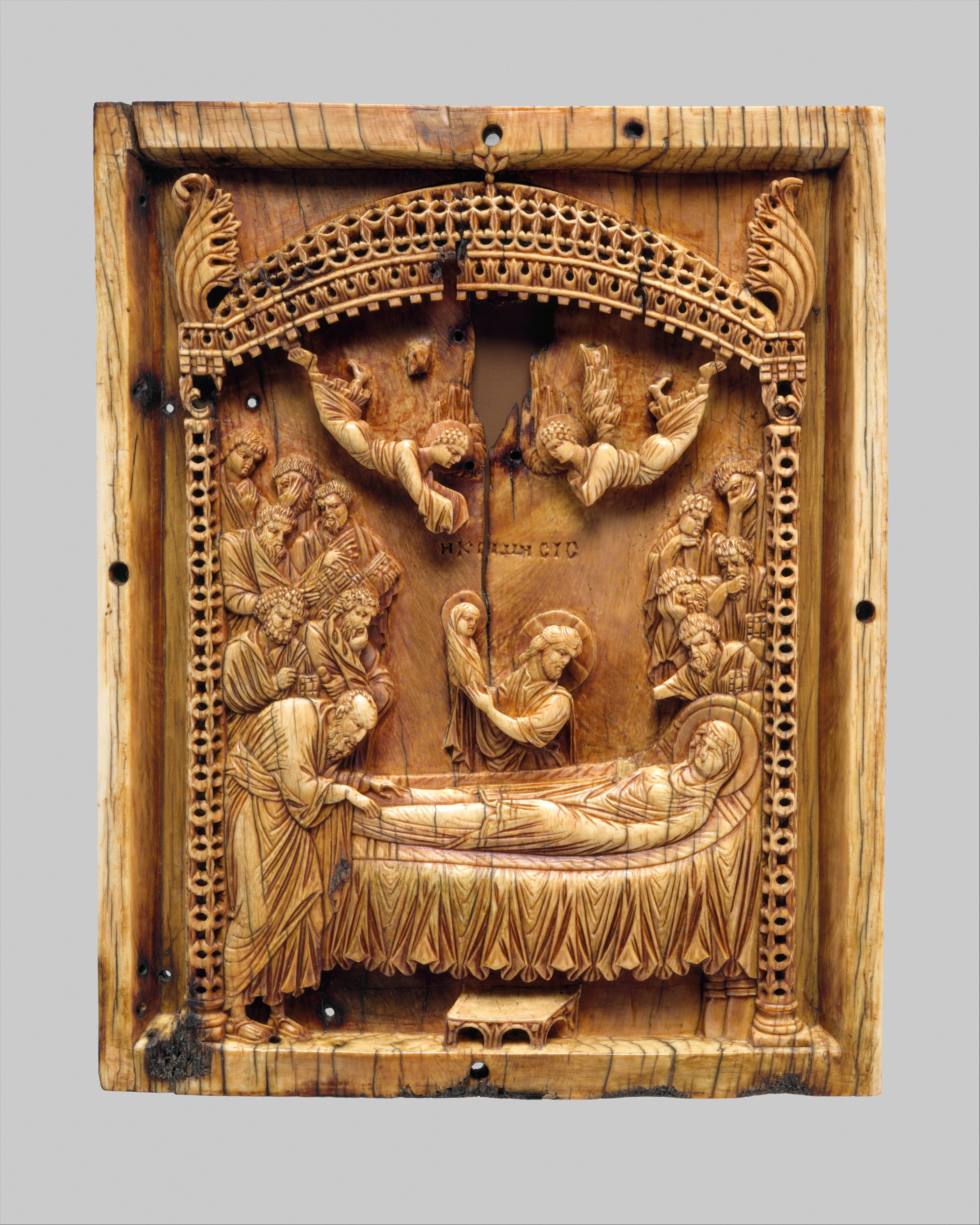
This small ivory of the Koimesis, or Dormition of the Virgin, was probably carved in Constantinople in the late tenth century, during a period of renewed ivory work under the Macedonian emperors. Christ lifts the Virgin’s soul, shown as an infant, towards angels while the apostles gather round her bier. Small enough to hold, it was made for one person’s prayer rather than for a church. The Cretan icon of the Virgin Eleousa in Cleveland, painted four and a half centuries later, shows the tradition continuing under Venetian rule as the empire itself shrank and fell in 1453.
Three ways to look
- 1Count the figures and find Peter and Paul at the head and foot of the bier.
- 2Notice how little depth the carver needed: the scene is arranged in bands rather than in receding space.
- 3Compare the ivory with the Cleveland icon. Which elements stayed fixed over four centuries, and which changed?
Continue with the collection
Related works · new publications appear when their period is identified
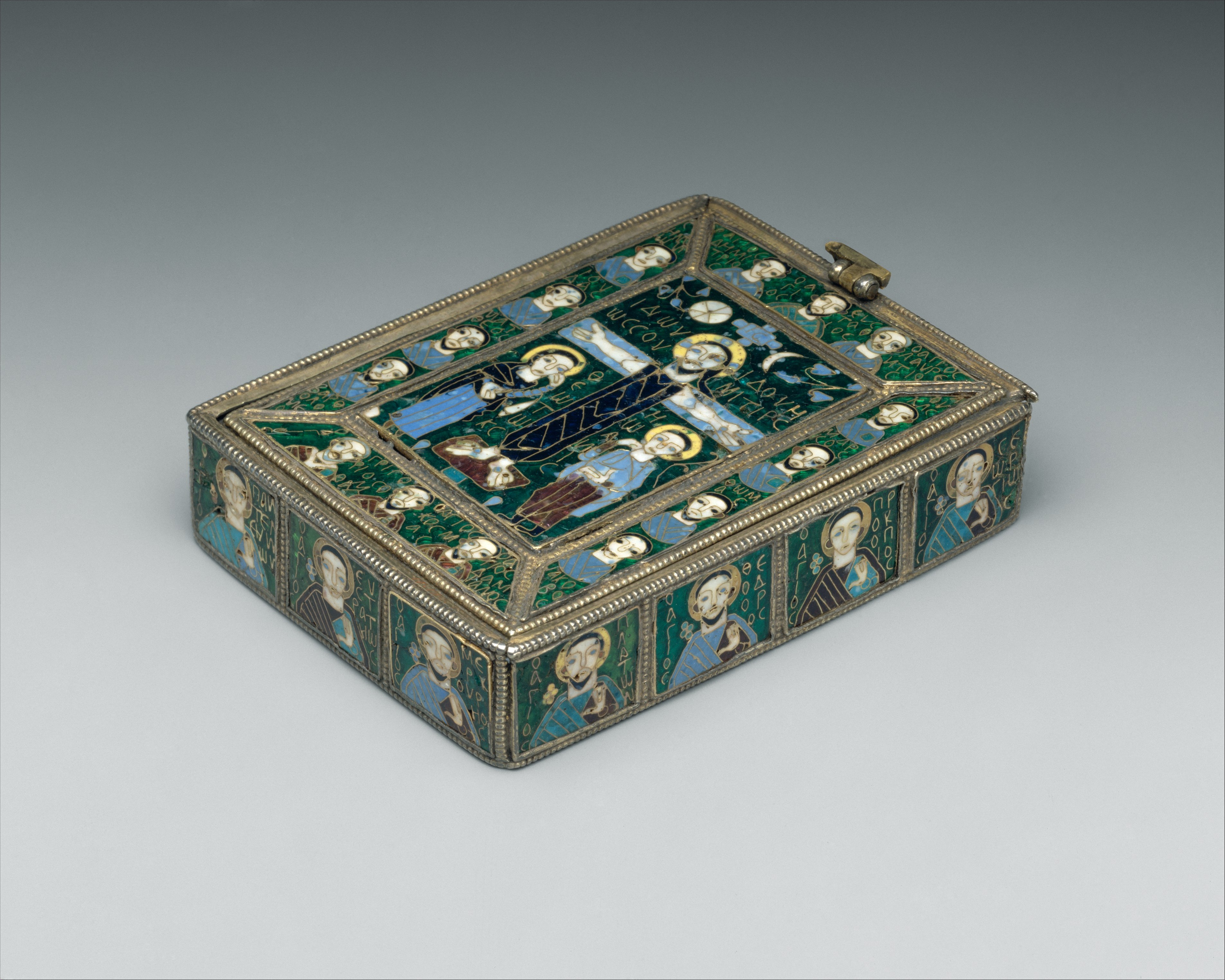
Byzantine
The Fieschi Morgan Staurotheke
Unknown maker · early 9th century
The Metropolitan Museum of Art
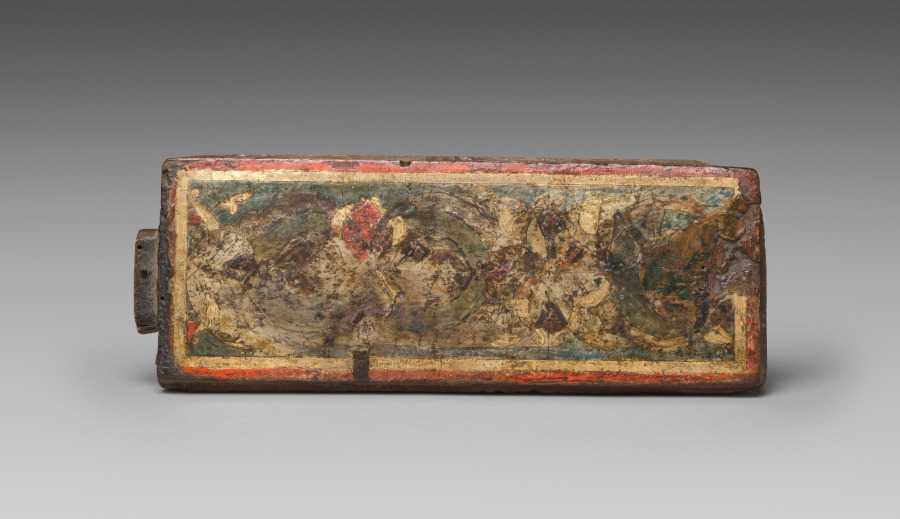
Byzantine
Reliquary Box with Scenes from the Life of John the Baptist (lid)
Unknown maker · 1300s
Cleveland Museum of Art
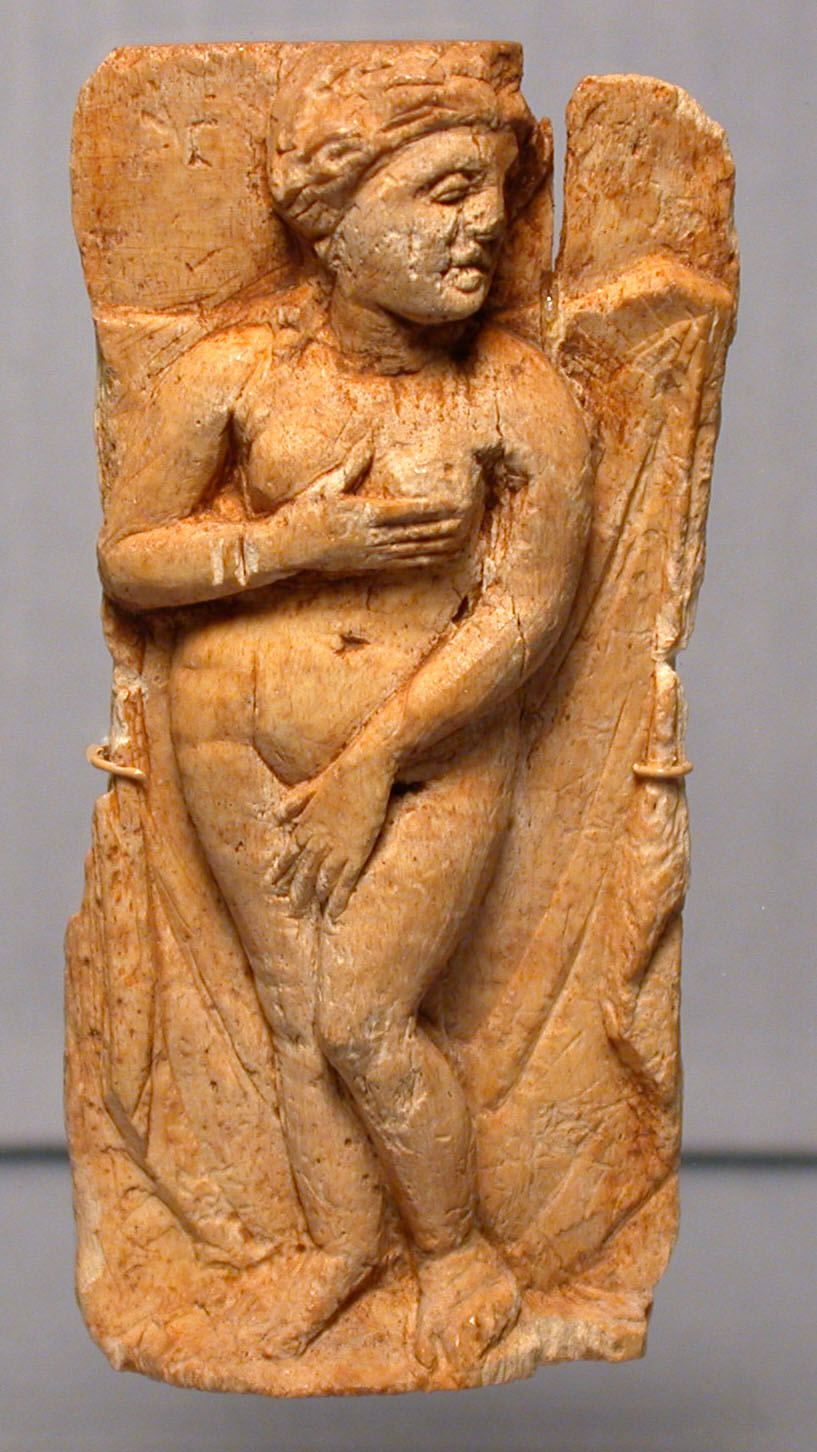
Byzantine
Panel of Venus, “Pudica Type”
Unknown maker · 4th–6th century
The Metropolitan Museum of Art
Sources & further reading · 2
Britain and Ireland
03 of 12
Insular art
c. 600–900
early 600s · Gold with garnets, glass, and niello
The Metropolitan Museum of Art · Purchase, Joseph Pulitzer Bequest, 1987
Gold, garnet and the knotted line.
In the centuries after Roman rule ended in Britain, the peoples of Britain and Ireland developed an art of interlace, animal ornament and jewelled metalwork. Its most famous survivals are gospel books such as the Lindisfarne Gospels and the Book of Kells, but the same taste for pattern shows in objects worn on the body.
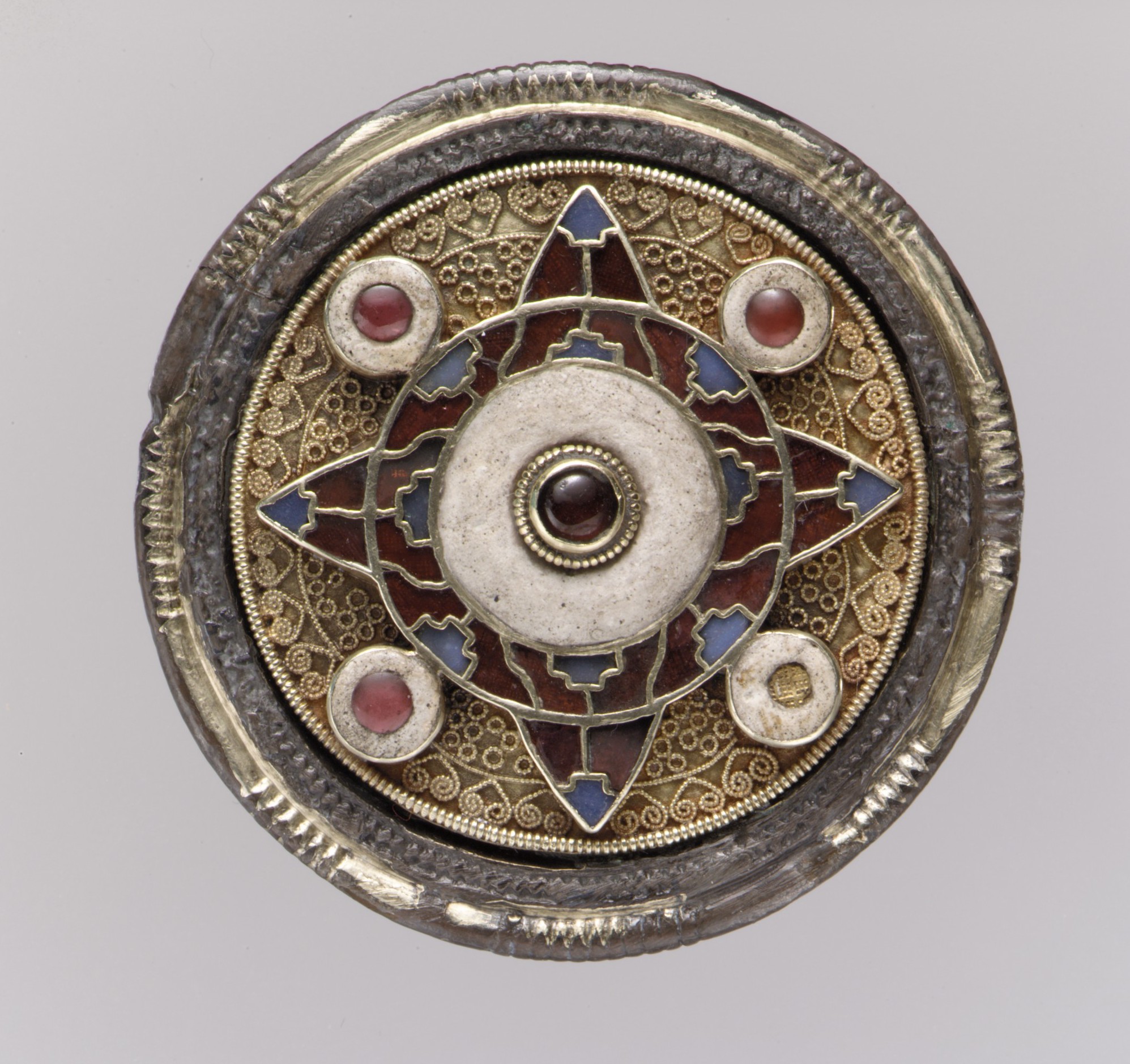
This disc brooch was made in Kent in the early seventh century, when the kingdom was a centre of Anglo-Saxon jewellery and had recently received Augustine’s mission from Rome. Garnets and glass are set in gold cells, with filigree interlace between them, the technique also seen in the Sutton Hoo burial of the same generation. Objects like this were worn in life and buried with their owners, which is why they survive. The great Insular manuscripts remain in Britain and Ireland; a brooch is one of the few ways an American collection can show the period at first hand.
Three ways to look
- 1Follow one strand of filigree and see whether it ever ends.
- 2Consider the size: under five centimetres. Ornament this dense was meant to be seen close, on a cloak.
- 3Ask what the colours signal. Red garnet against gold appears across northern Europe in this period, from Kent to Sweden.
Sources & further reading · 1
Francia, centred on Aachen
04 of 12
Carolingian renewal
c. 750–900
ca. 800–825 · Elephant ivory
The Metropolitan Museum of Art · Gift of J. Pierpont Morgan, 1917
Rome remembered at Aachen.
Charlemagne, crowned emperor in Rome in 800, gathered scholars and artists at his palace at Aachen and set them to recover the learning and the visual forms of Christian antiquity. Manuscripts, ivories and metalwork from his court and its successors look back to late Roman models with new confidence.
This ivory, among the largest single Carolingian panels to survive, was carved at Aachen in the first quarter of the ninth century. It shows the Virgin enthroned with a cross-topped staff and, in her other hand, the spindles that belong to the Annunciation; the Met reads the figure as both the Virgin receiving the angel’s news and a personification of the triumphant Church, a combination unique to this plaque. The egg-and-dart border and the peacocks in the corners are borrowed from classical ornament. Panels like this were usually made as book covers, joining the arts of the scriptorium and the workshop.
Three ways to look
- 1Trace the drapery folds: recent cleaning has made their rhythm easier to see.
- 2Find the two clues to the figure’s identity, the spindles and the staff, and decide which the carver has made more prominent.
- 3Look at the border before the figure. Which parts of the design come from Rome, and which do not?
Sources & further reading · 2
The German lands and northern Italy
05 of 12
Ottonian splendour
c. 950–1050
ca. 962–968 · Elephant ivory
The Metropolitan Museum of Art · Gift of George Blumenthal, 1941
An emperor holds up a church.
The Saxon emperors of the tenth and eleventh centuries, beginning with Otto I in 962, used art to bind their new empire to Rome, to Charlemagne and to Byzantium. Bishops and abbots close to the court commissioned ivories, gospel books and goldsmiths’ work of great ambition.
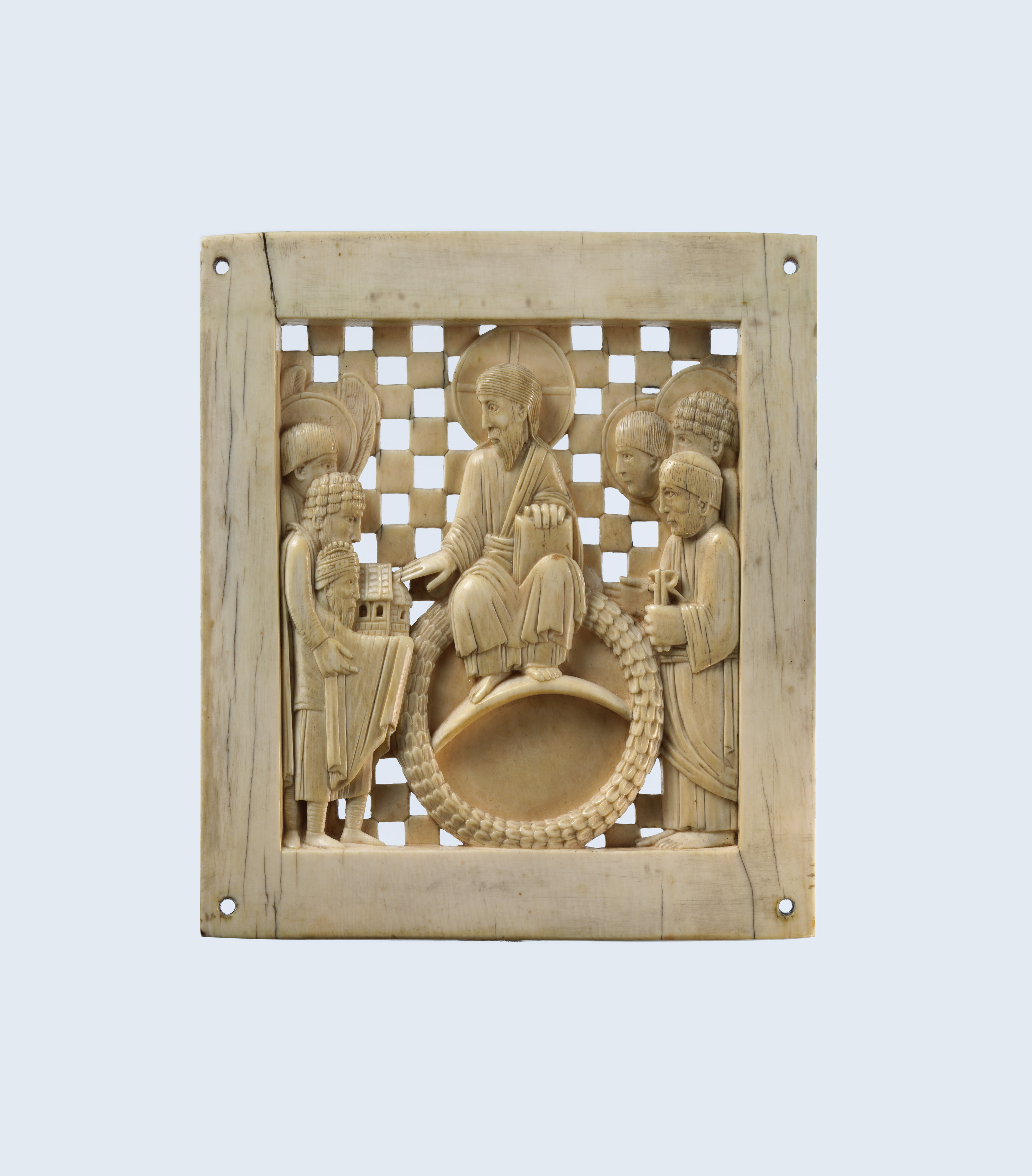
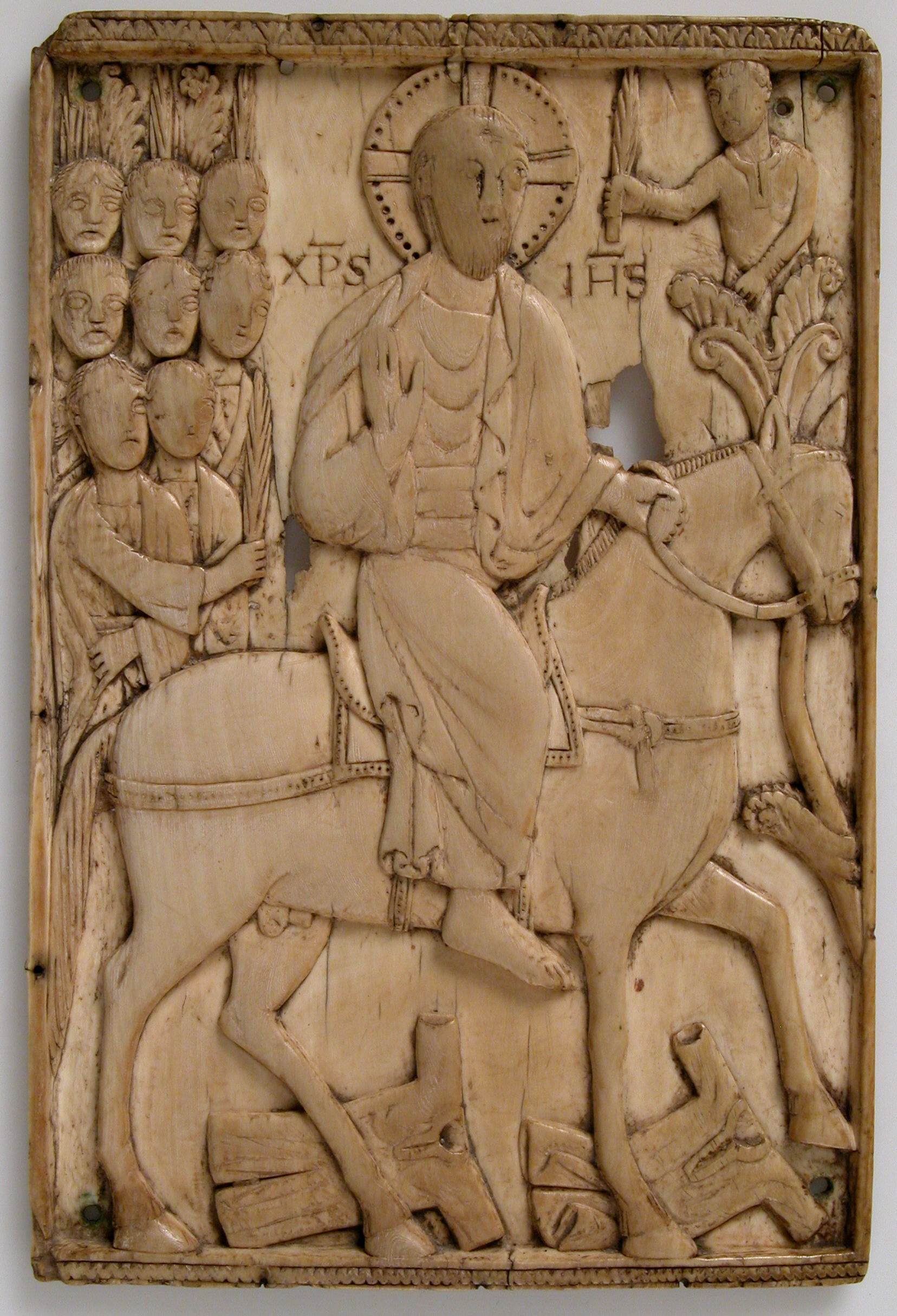
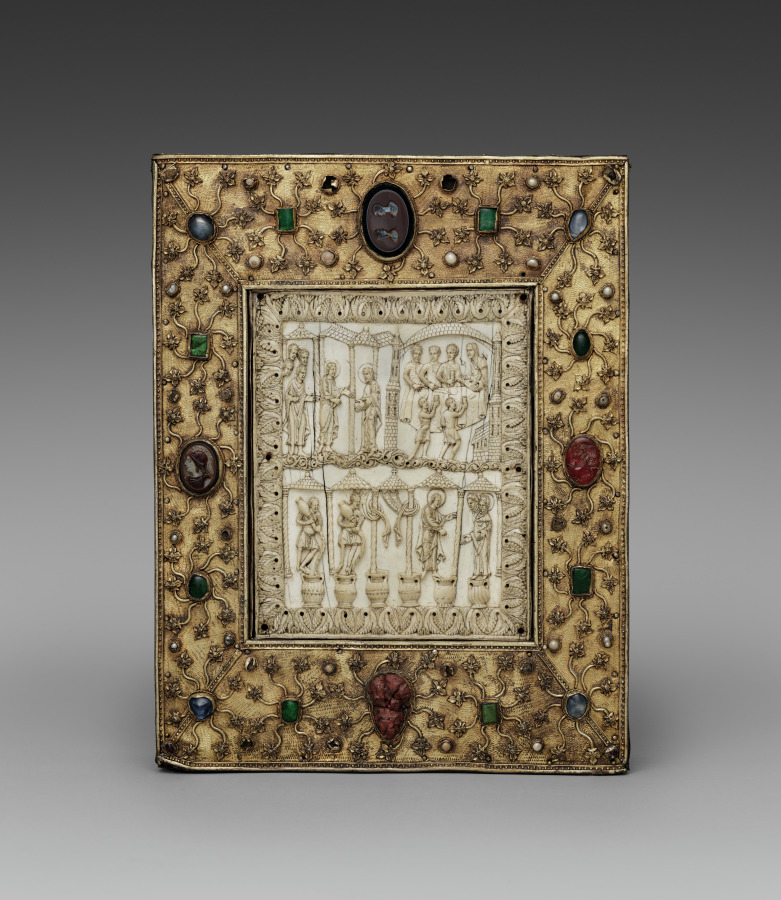
This plaque shows Christ enthroned before an openwork chequered ground, blessing a model church presented by Otto I. The emperor is shown smaller than the saints who accompany him; Peter holds his keys, and Saint Mauritius, patron of Magdeburg, is among them. The ivory was made for Otto’s church at Magdeburg, raised to an archbishopric in 968, and the Met suggests it and its companion panels were carved in Milan, perhaps for a chancel door, pulpit or altar frontal. The plain figures and emphatic gestures draw on Carolingian and Byzantine traditions at once; the marriage of Otto II to the Byzantine princess Theophanu in 972 deepened that contact.
Three ways to look
- 1Compare the scale of the emperor with that of the saints. What does the difference say about his claim?
- 2Look through the pierced ground behind Christ. The carver has removed ivory to let light and shadow do some of the work.
- 3Find the model church and ask what it tells you about the building it stands for.
Continue with the collection
Related works · new publications appear when their period is identified
Sources & further reading · 2
Western Europe
06 of 12
Romanesque
c. 1000–1200
ca. 1130–1140 · Birch with paint and glass
The Metropolitan Museum of Art · The Cloisters Collection, 1947
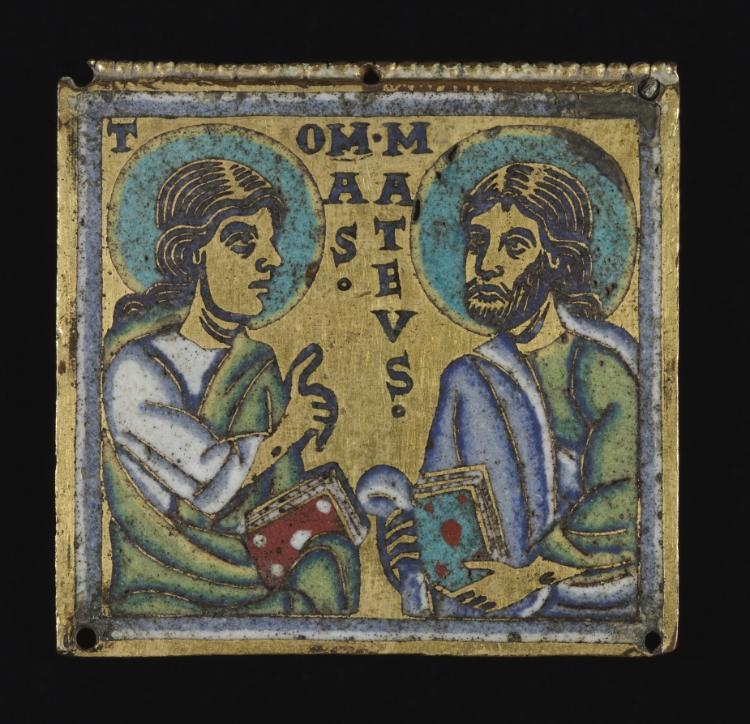
Sculpture returns to the church.
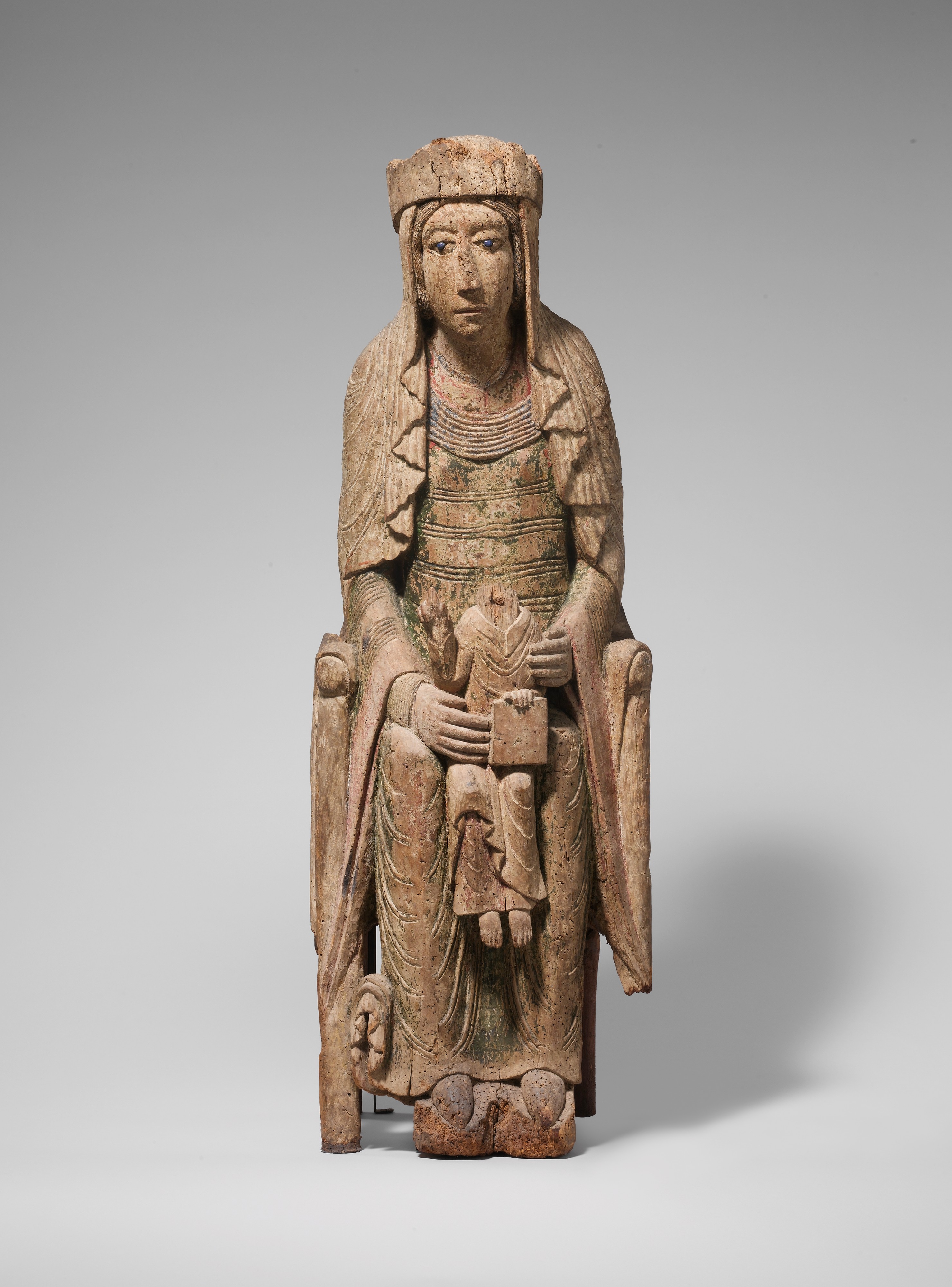
The eleventh and twelfth centuries saw churches rise across Europe along the pilgrimage roads and around the great monasteries. Carved portals and capitals, wooden cult statues and enamelled reliquaries gave these buildings faces, and the objects in this chapter were all made to be seen in them.
This Virgin, carved in birch near Autun in Burgundy around 1130 to 1140, is one of the few Romanesque wooden sculptures from the region to survive. She sits frontally and serves as a throne for her son, a type known as the Throne of Wisdom. The patterned drapery and heavy-lidded eyes relate her to the stone sculpture of the cathedral of Saint-Lazare at Autun, where the tympanum signed by Gislebertus was carved in the same decade. Traces of paint remain, and one blue glass eye is original. Statues like this stood on altars and were carried in procession; their stillness was a form of presence.
Three ways to look
- 1Follow the curved folds over the knees and compare them with the mantle at the shoulders.
- 2Look at the eyes. One is medieval glass, the other a modern replacement: which is which?
- 3Imagine the figure painted, on an altar, lit by candles. How much of the carving would you have seen?
Continue with the collection
Related works · new publications appear when their period is identified
Sources & further reading · 2
The Mediterranean frontiers
07 of 12
Crossroads: Iberia, Sicily & the Crusader east
c. 900–1300
ca. 1180 · Tempera, gold, and ink on parchment
The Metropolitan Museum of Art · Purchase, The Cloisters Collection, Rogers and Harris Brisbane Dick Funds, and Joseph Pulitzer Bequest, 1991
Where Latin, Greek and Arabic met.
Medieval art did not stop at the borders of Latin Christendom. In Spain, in Norman Sicily and in the Crusader states of the eastern Mediterranean, Christian, Muslim and Jewish makers and patrons lived close together, and objects show the results: silks with Arabic inscriptions, churches with mosaics in the Byzantine manner, manuscripts whose colour belongs to more than one tradition.
This leaf from a Spanish Commentary on the Apocalypse, made around 1180, shows the fourth angel sounding a trumpet as the sun, moon and stars darken, and an eagle crying woe. The commentary was written by Beatus of Liébana, an eighth-century Asturian monk, and illustrated copies were made in Spanish monasteries for centuries; the Met describes them as unique to medieval Spain. The flat bands of colour and strong outline developed in a peninsula where Islamic al-Andalus was a neighbour and, at times, a ruler. The manuscript from which this leaf comes was taken apart in the 1870s, a reminder that dispersal is part of the history of many medieval books.
Three ways to look
- 1Read the page as bands of colour before you read it as a scene.
- 2Find the eagle and the darkened lights of heaven, and ask how the painter signals catastrophe without depth or shadow.
- 3Compare the palette with the Met’s Parisian glass or Duccio’s panel. What is shared, and what belongs to Spain?
Sources & further reading · 2
Northern France and beyond
08 of 12
The Gothic cathedral
c. 1140–1300
1245–47 · Pot-metal glass, vitreous paint
The Metropolitan Museum of Art · The Cloisters Collection, 1973
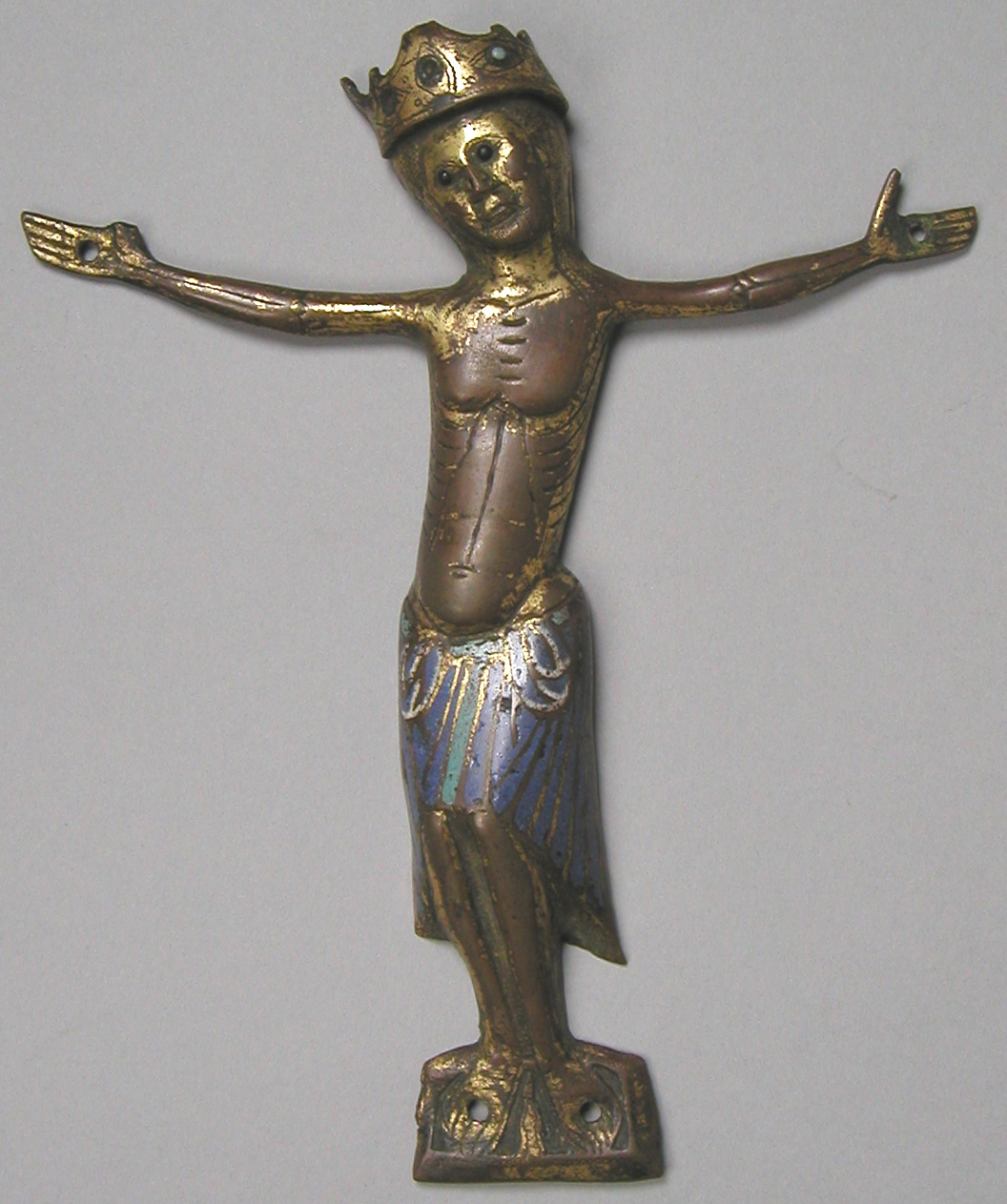
Walls of glass.
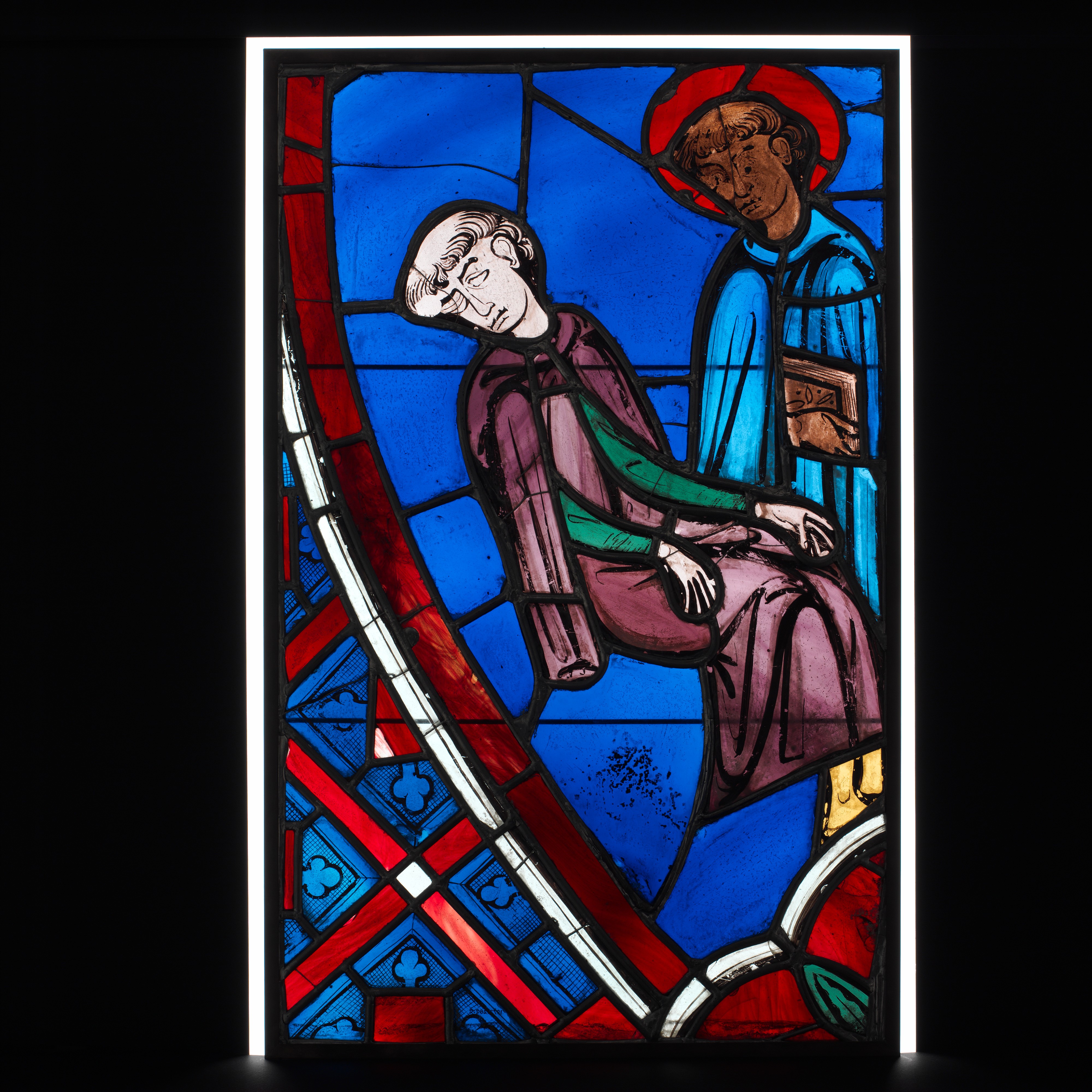
From the rebuilding of the abbey church of Saint-Denis in the 1140s, architects in the Île-de-France used pointed arches, rib vaults and flying buttresses to open walls and fill them with coloured glass. Chartres, Reims, Amiens and the Sainte-Chapelle followed within a century, and the style spread across Europe.
This panel of 1245 to 1247 comes from the abbey of Saint-Germain-des-Prés in Paris and shows the saint appearing posthumously in a dream to a monk of his community. The figures fill a deep blue ground with almost no setting, and the drama is carried by the monk’s curved pose and averted face. The glass was painted in the same years and the same city as the Sainte-Chapelle, and belongs to a Parisian glazing culture that supplied the new churches of the capital. Seen in place, a panel like this was one small unit in a window several metres high; on a museum wall it can be read at arm’s length.
Three ways to look
- 1Find the lead lines and notice where the glazier used them as drawing.
- 2Look at the blue. Pot-metal glass is coloured through its whole thickness, which is why it holds its depth in strong light.
- 3Compare the amount of painted detail on faces with that on drapery. Where did the painter spend his time?
Continue with the collection
Related works · new publications appear when their period is identified
Sources & further reading · 2
Paris and the courts of France
09 of 12
The illuminated page
c. 1150–1450
ca. 1324–28 · Grisaille, tempera, and ink on vellum
The Metropolitan Museum of Art · The Cloisters Collection, 1954
A book held close.
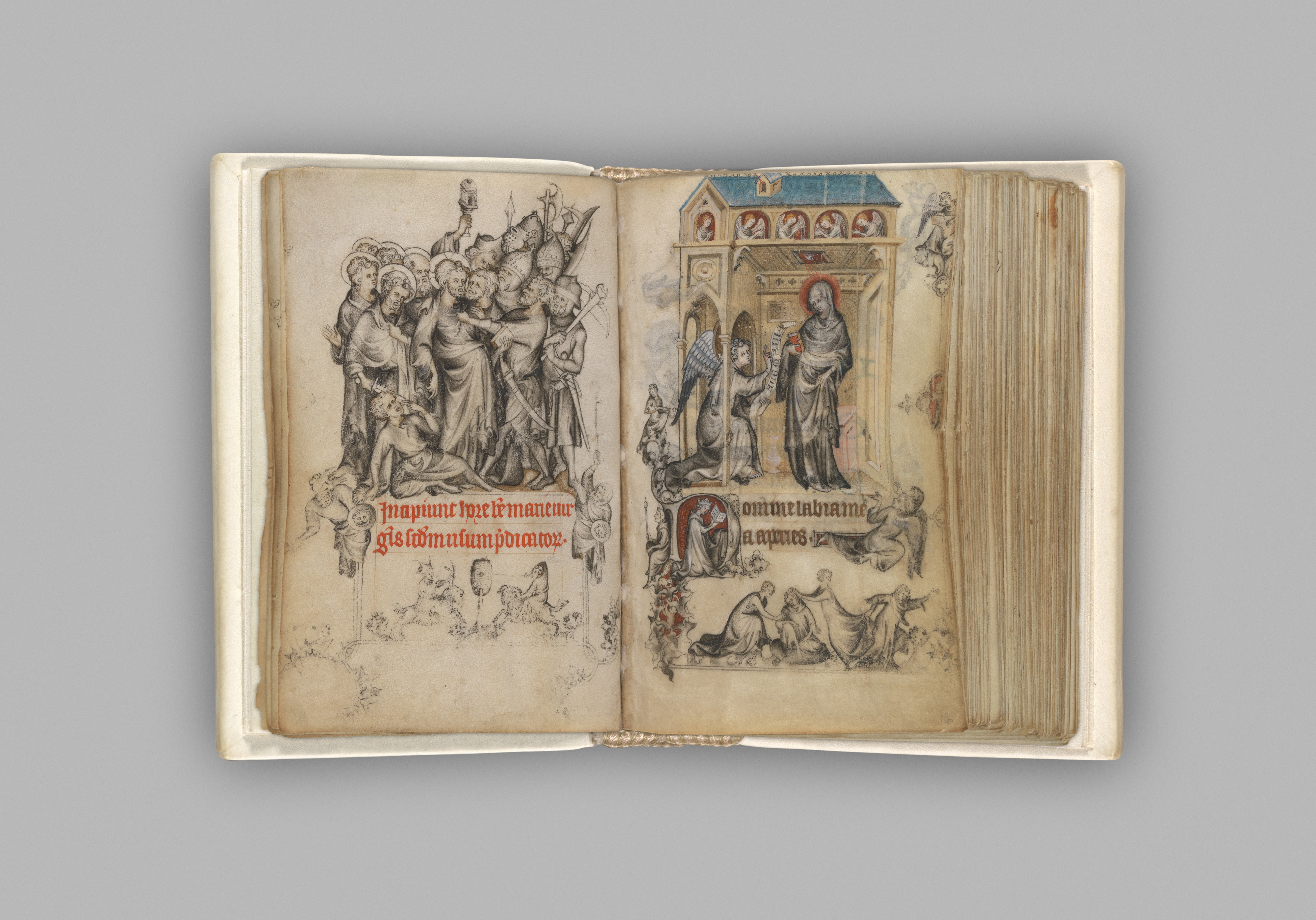
By the thirteenth century Paris was the centre of a commercial book trade serving the university, the court and wealthy lay readers. Books of hours, made for private prayer, became the most common illuminated books of the later Middle Ages, and the finest were painted by named artists for named patrons.
The Hours of Jeanne d’Evreux, painted around 1324 to 1328 by Jean Pucelle, is small enough to sit in the palm and contains no gold. Its figures are modelled in grisaille with touches of colour, and its 209 folios include twenty-five full-page paintings and close to seven hundred marginal figures. The queen’s testament names Pucelle as its illuminator, which is rare. A century later the Limbourg brothers painted the Belles Heures for Jean de Berry, who had also owned the Hours of Jeanne d’Evreux. The two books, now in the same gallery at The Met Cloisters, mark the beginning and the end of this chapter.
Three ways to look
- 1Work out the direction of light in the miniature, then check whether the margins share it.
- 2Find one marginal figure that comments on the scene above and one that ignores it.
- 3Compare the page with a leaf from the Belles Heures. What did a century add, and what did it lose?
Continue with the collection
Related works · new publications appear when their period is identified
Sources & further reading · 2
Paris and the church treasuries of Europe
10 of 12
Courtly ivories & the treasury
c. 1250–1400
ca. 1310–30 · Elephant ivory
The Metropolitan Museum of Art · Gift of J. Pierpont Morgan, 1917; The Cloisters Collection, 1988
Romance in the palm of the hand.
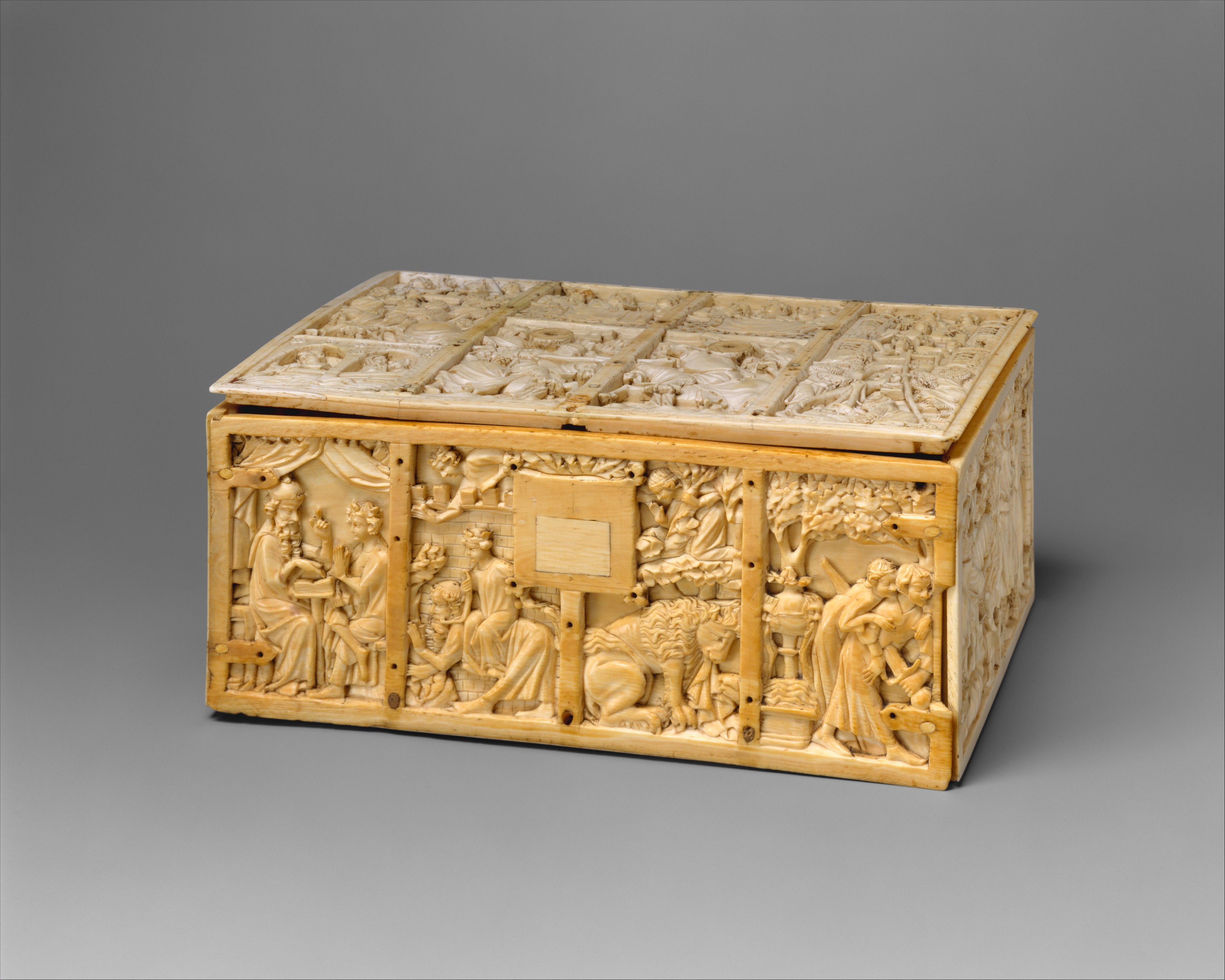
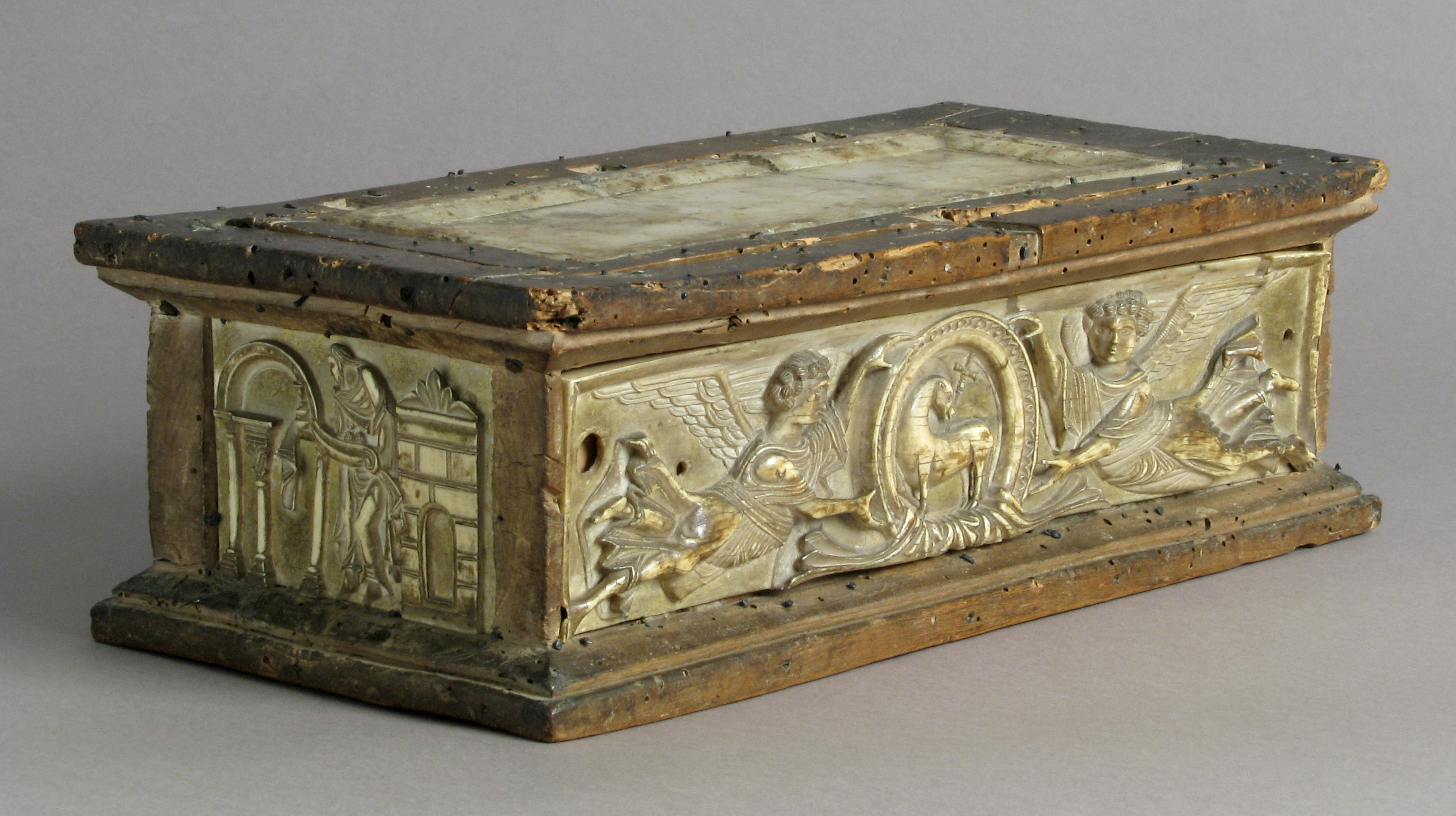
Elephant ivory reached Paris in quantity from the mid-thirteenth century, and its carvers supplied both the church and the household: diptychs and statuettes for prayer, and caskets, mirror cases and combs decorated with scenes of love and chivalry. Church treasuries, meanwhile, gathered reliquaries and liturgical objects in gold, enamel and crystal.
This casket, carved in Paris around 1310 to 1330, is among the most complete of its kind. Its lid shows the assault on the Castle of Love, with knights catapulting roses; its sides show Tristan and Isolde spied on by King Mark, Lancelot crossing the sword bridge, Gawain on the perilous bed and a knight rescuing a lady from a wild man. The front panel, with Aristotle and Phyllis and the deaths of Pyramus and Thisbe, was lost before 1800 and rejoined the box in 1988. Boxes like this were probably gifts within courtly households, and the stories they carry were as familiar to their owners as scripture.
Three ways to look
- 1Pick one side and try to name the story before reading the label.
- 2Notice how the carver fits a narrative into a strip a few centimetres high. Where does one scene end and the next begin?
- 3Compare the secular casket with the Chasse of Champagnat. What do a love story and a relic have in common as things to be kept in a box?
Sources & further reading · 2
Paris, Dijon and the princely courts
11 of 12
International Gothic & the Burgundian court
c. 1380–1450
1405–1408/1409 · Tempera, gold, and ink on vellum
The Metropolitan Museum of Art · The Cloisters Collection, 1954
A shared style for the courts of Europe.
Around 1400 artists moving between the courts of France, Burgundy, Bohemia and northern Italy produced a recognisably shared manner: slender figures, rich fabrics, and a growing curiosity about animals, plants and weather. The dukes of Burgundy, ruling from Dijon, were among its most demanding patrons.
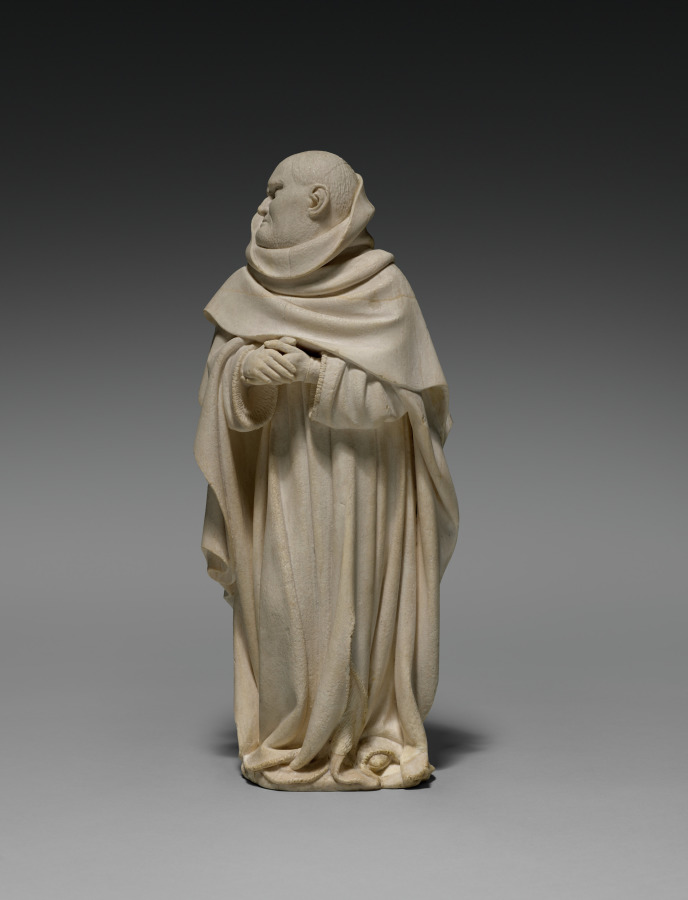
The Belles Heures, made for Jean de Berry between 1405 and 1408 or 1409, is the only manuscript the Limbourg brothers completed in its entirety. Its 172 illuminations include seven picture cycles chosen for the duke, painted in a luminous palette that joins northern observation with Italian ways of building a figure. In Dijon, the duke’s brother Philip the Bold had founded the Charterhouse of Champmol as his burial place; the small alabaster mourners around his tomb, begun under Claus Sluter and completed by Claus de Werve in 1410, translate grief into folds of cloth. The Cleveland mourner in this collection is one of them.
Three ways to look
- 1In the Belles Heures leaf, find a passage of landscape or costume that could only have been painted from observation.
- 2Turn to the mourner and ask where the expression is. The face is hidden; the cloth does the work.
- 3Both objects were made for brothers. Consider how patronage, not only style, links a book in Paris with a tomb in Dijon.
Continue with the collection
Related works · new publications appear when their period is identified
Sources & further reading · 2
Germany, the Netherlands and France
12 of 12
Late Gothic: altarpieces & the printed image
c. 1400–1520
c. 1495 · Alabaster, traces of polychromy
Cleveland Museum of Art · Purchase from the J. H. Wade Fund
The last carved altarpieces, the first printed pictures.
In the fifteenth century northern workshops produced large carved and painted altarpieces, tapestries for the court and instruments for the study. The same decades saw woodcuts and, from the 1450s, printed books put images into far more hands. The period closes with the Reformation, which changed what churches in much of northern Europe wanted from art.
Tilman Riemenschneider ran one of the largest sculpture workshops in Franconia from Würzburg, and is best known for limewood altarpieces left unpainted. This Saint Jerome, made around 1495 for the church of Saint Peter in Erfurt, is one of his rare works in alabaster; conservators have found traces of colour, including a red mouth and yellow fur on the lion. Alongside it, the Unicorn Tapestries woven around 1500 and the astrolabe made for Cardinal Bessarion in 1462 show the range of late medieval making. Riemenschneider sided with the townspeople in the Peasants’ War of 1525 and was imprisoned; few works are recorded after that date.
Three ways to look
- 1Look at the lion’s paw and Jerome’s fingers: the thorn is the whole subject.
- 2Search for traces of colour. The white we see is not what the first viewers saw.
- 3Compare the alabaster with the tapestry’s flowering ground and the astrolabe’s engraved sky. Which of the three would have been seen by the most people?
Continue with the collection
Related works · new publications appear when their period is identified
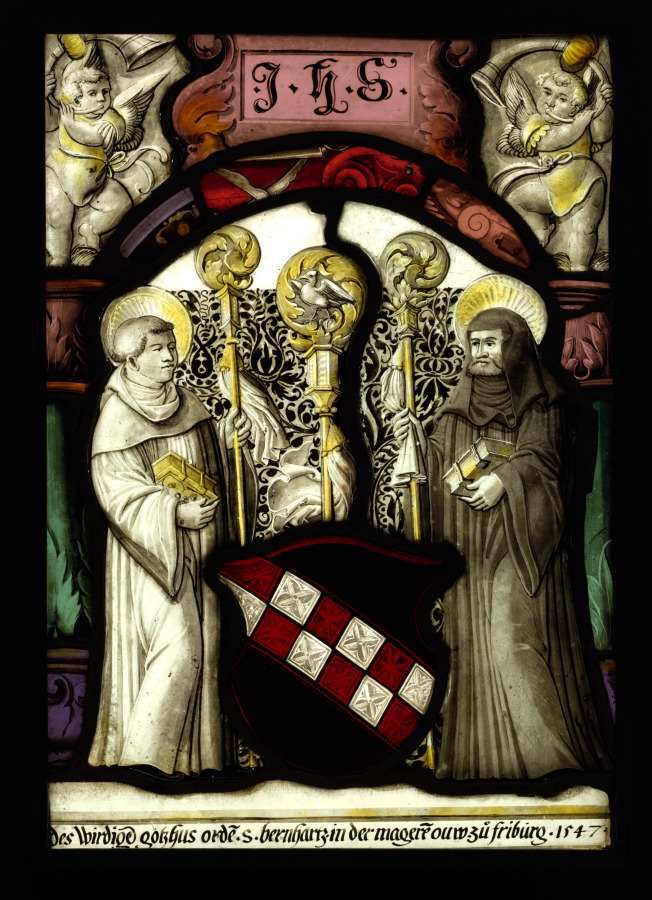
Late Gothic
Arms of the Cistercian Order
Unknown maker · 1547
Cleveland Museum of Art
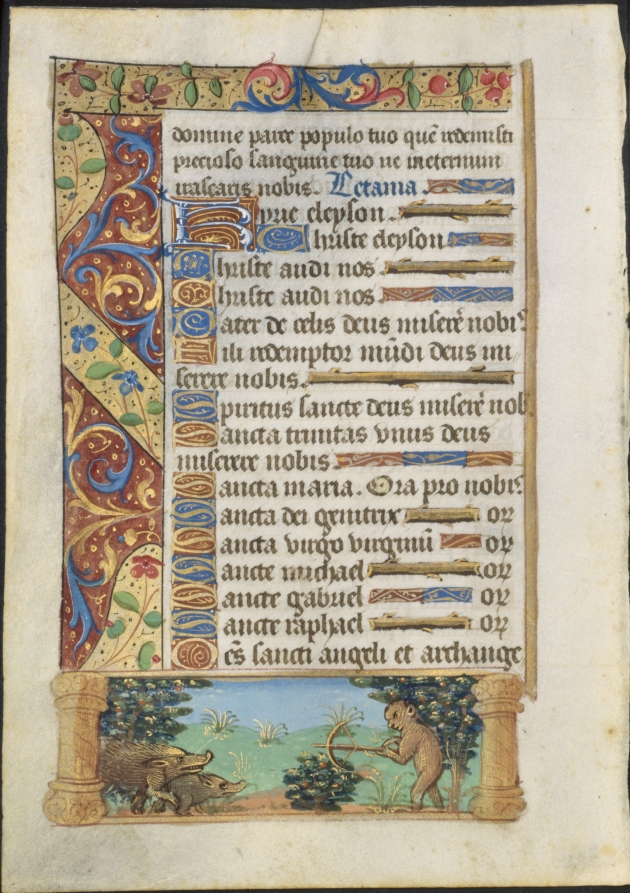
Late Gothic
Leaf from a Book of Hours: Ape Hunting Wild Boars (recto)
Unknown maker · c. 1500–1510
Cleveland Museum of Art
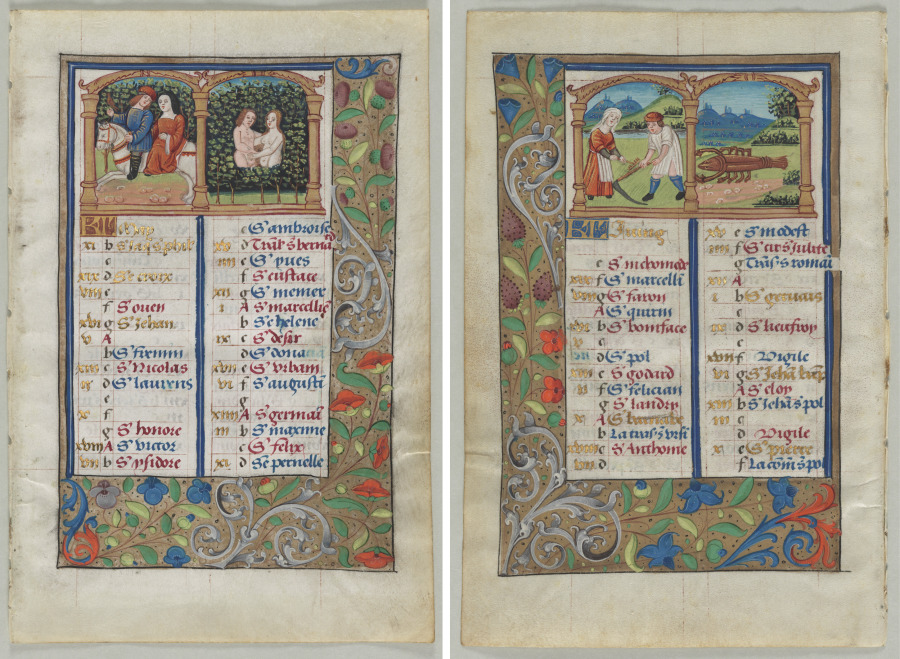
Late Gothic
Leaf from a Book of Hours: Calendar Page for May (recto) and Calendar Page for June (verso) (2 of 3 Excised Leaves)
Unknown maker · c. 1510
Cleveland Museum of Art
Sources & further reading · 2
Keep looking
History is also what an object carries with it.
Dates, attributions, and interpretations can change with research. Follow the museum records for provenance and current scholarship. This selection will grow; its gaps should remain visible.
Explore the collection