Close looking
8 September 2026
6 min read
Reading a Book of Hours
The Hours of Jeanne d’Evreux is smaller than a hand. Looking at it closely means thinking about who held it, when, and what she saw in its margins.
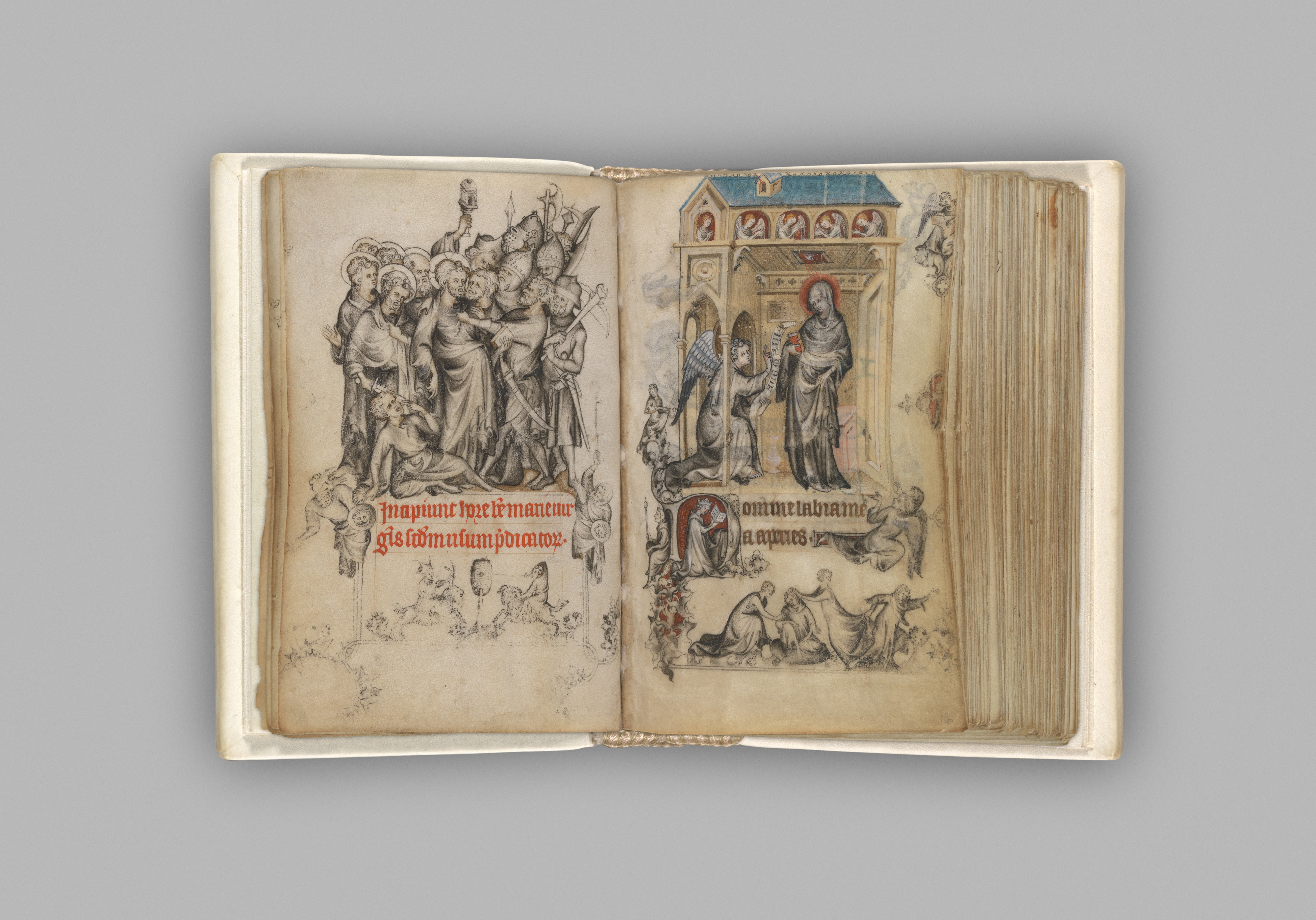
Opening of the Hours of Jeanne d’Evreux with facing grisaille miniatures
A book made for one pair of hands
A book of hours is a collection of prayers arranged around the canonical hours of the day, adapted for lay use. By the fourteenth century it was the book a wealthy layperson was most likely to own, and it was often the only one. The Hours of Jeanne d’Evreux, painted in Paris around 1324 to 1328, was made for a queen of France, and its measurements are the first thing to register: each page is a little over nine centimetres high. On a museum wall the manuscript is shown open at one spread, but its scale tells you that it was designed to be held close to the face, turned page by page, in private.
The queen’s testament describes the book as the one “that Pucelle illuminated”, which is how the name of Jean Pucelle, a Parisian artist documented between 1319 and 1334, came to be attached to it. That link is unusual. Most medieval illuminators are anonymous, and where names survive they are often attached to payments rather than to specific pages. Here the patron herself, decades after the book was made, still thought of it as his work.
Grey figures, coloured borders
The miniatures are painted almost entirely in grisaille, shades of grey built up from a dark drawing to pale highlights, with touches of lilac, turquoise and rose in the settings. There is no gold. In a book for a queen this is a deliberate choice, and it produces figures that read as small sculptures, with rounded drapery and a sense of weight. The full-page paintings are arranged in pairs across the opening, so that a scene from the Passion faces a scene from the Infancy of Christ: the Betrayal of Christ opposite the Annunciation, for example, so that the reader sees the beginning and the end of the story at once.
The margins do something else. Close to seven hundred small figures fill the lower edges and the spaces around the text: bishops and beggars, dancers, musicians, rabbits, apes and creatures that belong to no natural history. Some comment on the scene above, some seem to play against it, and some are simply the life of a Paris street. Scholars continue to argue about how far these images were meant to be read, and how far they were enjoyed. The honest answer is probably both, and that a reader who used the book daily over many years would have found different things in them at different times.
How to look at a page you cannot turn
In the museum you see one opening. Start with what is in front of you: find the direction of light in the miniature, follow the line of a hem or a sleeve, and notice how the grey is modelled. Then look at the text, even if you cannot read the Latin. The size of the script, the coloured initials and the line-endings tell you how the page was organised before any picture was added. Finally look at the margin, and ask which figures face the text and which face away.
Then think about the object as a whole. The Met records 209 folios and twenty-five full-page paintings, and those paintings include scenes from the life of Saint Louis, the queen’s ancestor, alongside the Gospel narrative. A book of hours was a devotional tool, a family possession and a statement of taste. It passed from Jeanne d’Evreux to Charles V and then to his brother Jean de Berry, the patron of the Belles Heures, which is displayed in the same gallery. Reading a book of hours means holding those uses in mind together, and accepting that the page in front of you is one of several hundred you will not see.