Object story
8 September 2026
6 min read
What a reliquary asks of its viewer
The Chasse of Champagnat is a small enamelled box that once held the remains of a saint. Its images were made to be seen by people who already believed in what was inside.
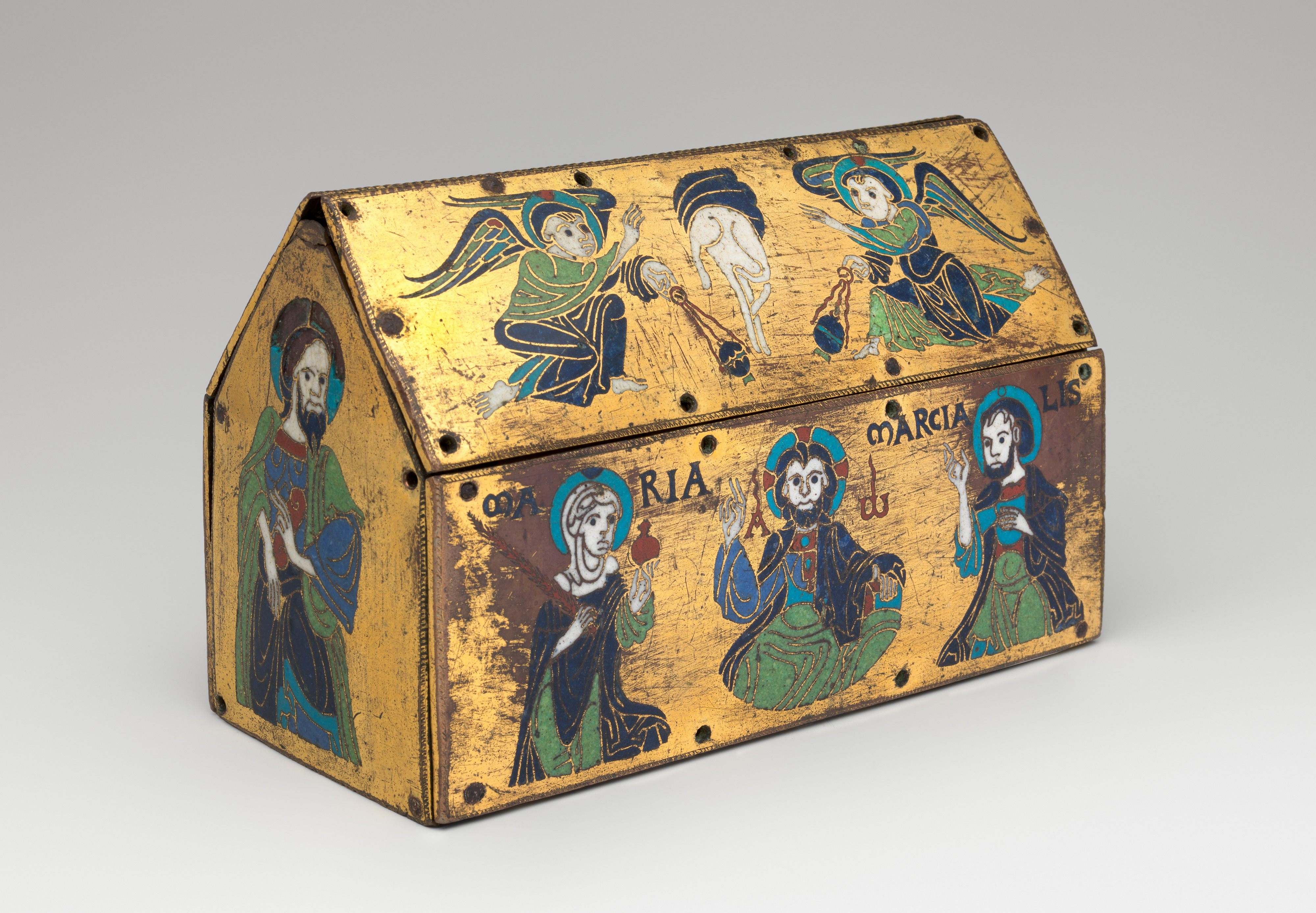
The Chasse of Champagnat, a gilded copper reliquary with enamelled figures
A house for a body
A chasse is a reliquary shaped like a small building, with a pitched roof and a ridge, and the form is not accidental. It housed relics, the physical remains of a saint or objects that had touched them, and the shape declares that what is inside has a home. The Chasse of Champagnat, made in Limoges around 1150, is under nineteen centimetres long. It came from the church of Saint-Martial at Champagnat, in the diocese of Limoges, where Martial, the city’s first bishop, was honoured as a thirteenth apostle.
Relics were the point of contact between the living and the holy. A church that owned them drew pilgrims, gifts and standing, and a container that was worth looking at increased the sense that the contents were worth travelling for. The champlevé enamel of Limoges, with its deep blues and greens set into gilded copper, was well suited to the task: durable, bright in candlelight and produced by workshops that could supply churches across Europe.
Reading the front, the roof and the back
The Met’s record describes the programme. On the principal face Christ appears at the centre, marked by a cross in his halo, holding a book and raising his hand in blessing, with the Greek letters alpha and omega at either side. To his right is a female saint inscribed as Maria, understood as Mary Magdalene, holding an ointment jar and a palm; to his left is Martial, raising his own hand in blessing. On the roof plaque above, the hand of God appears between two angels swinging censers. Saint Peter, with red-enamelled keys, and a second saint who is probably Paul occupy the ends, and the symbols of the four Evangelists stand at the corners of the reverse, turning their heads towards the centre, where foliage springs from beasts with human faces.
That arrangement puts the local saint beside Christ himself, on the side of the box that faced the congregation. It is a claim about Martial’s importance, and about the importance of the church that held his relics or those of his companions. The reverse, with its Evangelists and foliage, was the side seen by the clergy at the altar. A reliquary was designed with more than one audience in mind, and each side speaks to the people most likely to be standing in front of it.
Looking without believing
The chasse now sits in a glass case in a New York gallery, empty of its relics, and it is worth asking what it asks of a viewer who does not share the faith it was made for. First, it asks for attention to scale. The figures are a few centimetres tall, yet they were expected to hold a space that might contain hundreds of people. Second, it asks for an awareness of light. Gilded copper and glass enamel do very different things under a candle than under gallery lamps, and the surfaces were meant to move.
Third, and most difficult, it asks the viewer to take the contents seriously as the reason for the object. A reliquary is not a picture with a box behind it; it is a box, and the pictures explain and protect what is inside. Looking well at the Chasse of Champagnat means holding that inversion in mind, and treating the absent relic as the centre of the design. The images do the work of persuasion. The viewer, then as now, is invited to decide whether to be persuaded.