
- Period
- Medieval collection
- Date
- c.1310
- Collection
- Cleveland Museum of Art
- Object no.
- 1999.125
Leaf from a Psalter: Historiated Initial D with The Trinity
Master of the Queen Mary Psalter (English), c.1310
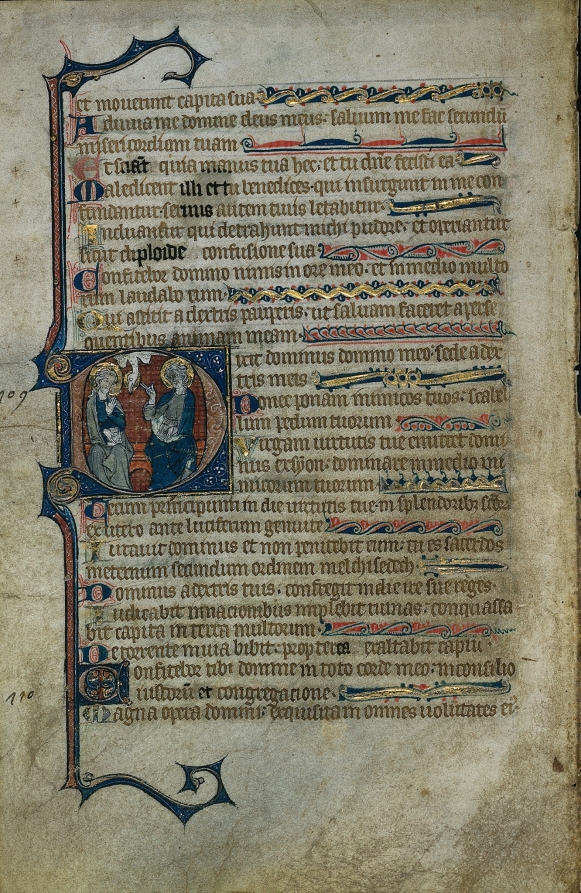
Cleveland Museum of Art · The Jeanne Miles Blackburn Collection · Public domain
- Maker
- Master of the Queen Mary Psalter (English)
- Date
- c.1310
- Medium
- ink, tempera and gold on vellum
- Dimensions
- Each leaf: 26.7 x 17.5 cm (10 1/2 x 6 7/8 in.)
- Period
- Medieval collection
The record
Why it matters
Although English, the design of this psalter page follows the fashion of French book illumination. In particular, the white flesh tones, elegant wavy coiffures, and elongated fingers of the figures relate this leaf to the Queen Mary Psalter, probably the most "Parisian" of all surviving English illuminated manuscripts of the early 1300s. The Queen Mary Psalter is named after the 16th-century English queen who appears to have once owned it. The artistic connections between France and England during this period are puzzling and often show influence moving in both directions. The workshop of the Queen Mary Psalter appears to have been active in East Anglia between 1310 and 1335, though its specific location remains unknown. It presumably competed with workshops in Norwich, Cambridge, Bury St. Edmunds, and the so-called "Fenland" workshops. A large initial D for Dixit dominus domino. . . . (The Lord said unto my Lord. . . . ) introduces the text, the opening of Psalm 109, within which appears the Trinity.