- Period
- Romanesque
- Date
- 1050–1100
- Collection
- Cleveland Museum of Art
- Object no.
- 1922.359
Plaque from a Portable Altar Showing the Crucifixion
Unknown maker, 1050–1100
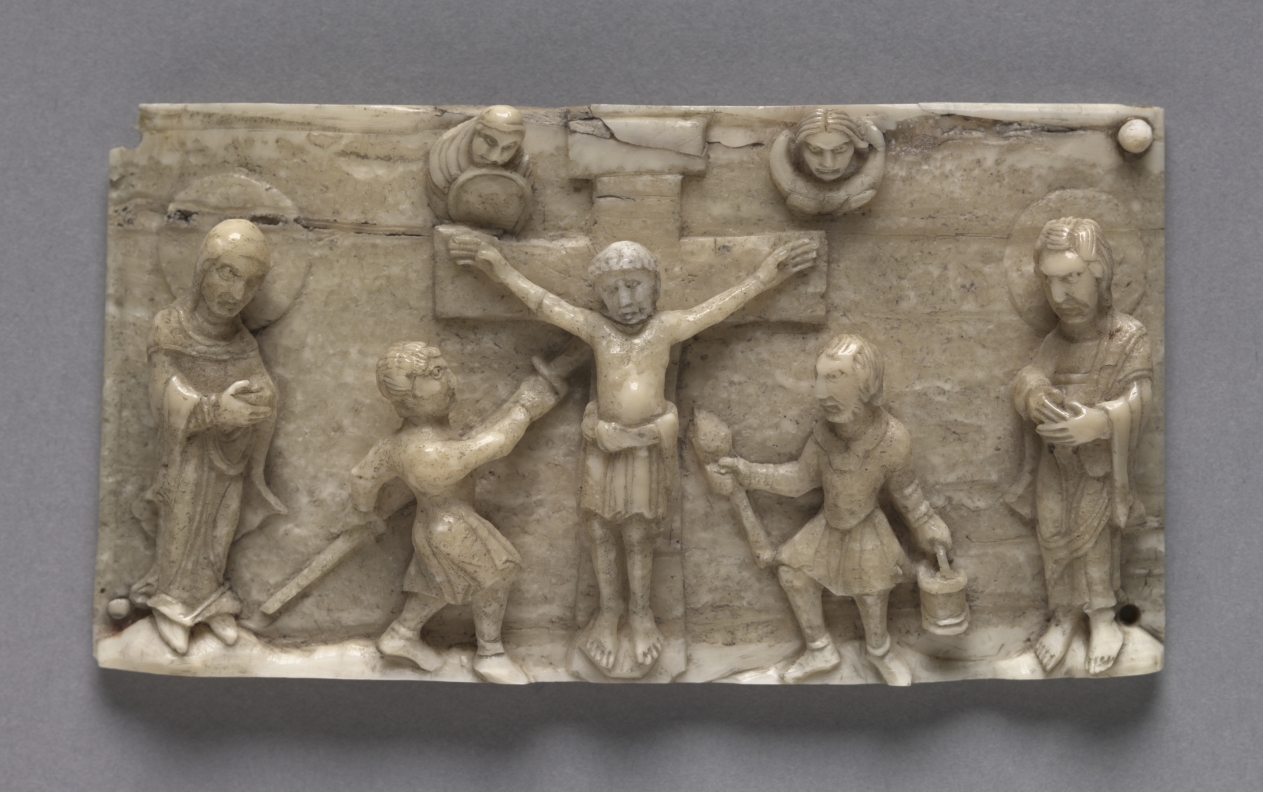
Cleveland Museum of Art · Gift of Arnold Seligmann, Rey and Company, Inc. · Public domain
- Maker
- Unknown maker
- Date
- 1050–1100
- Medium
- walrus ivory
- Dimensions
- Overall: 5.1 x 9.6 cm (2 x 3 3/4 in.)
- Period
- Romanesque
The record
Why it matters
These intricately carved ivory panels once decorated the sides of a portable altar. Three of the plaques, those depicting Christ in Majesty and his apostles, were the first major acquisition of William M. Milliken, the museum's first curator of decorative arts and later director (1930–58). They were purchased from Emile Rey, the New York partner of Arnold Seligmann, Rey and Company, who had been closely associated with J. P. Morgan, Henry Walters, and other important American collectors. The fourth plaque, depicting the Crucifixion, was donated by Arnold Seligmann, Rey and Company later the same year. As Milliken later recalled, the pieces Rey showed him "were immensely intriguing, monumental in scale, even if tiny in size, the Christ in the Mandorla could have been enlarged and would have graced the tympanum of a great cathedral. . . . These morse [that is, walrus] ivories overwhelmed me . . . Somehow they must come to Cleveland. How was the question. Yet they would and must."