
Journal
The Shock of the New: Hubert Gerhard's Resurrection Relief
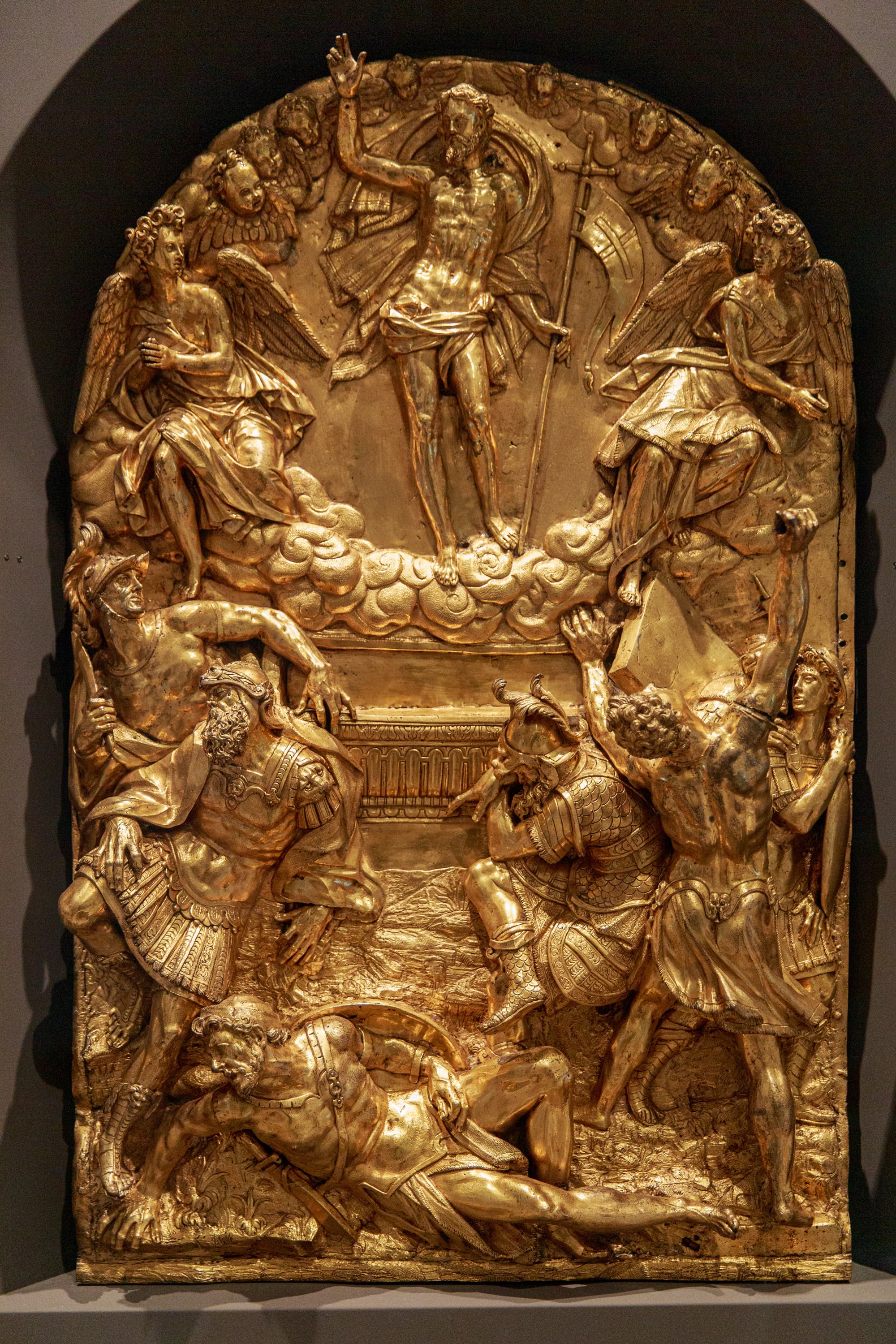
At the base of a gilded bronze Resurrection, Roman soldiers writhe in theatrical panic while Christ floats above them in absolute calm. Made between 1581 and 1584, this relief shows exactly when church art stopped being symbolic and started being staged.
By Rob Polli · 22 September 2026 · 5 min read
Start at the bottom. Before you look at Christ, before you find the angels, look at the soldiers.
In Hubert Gerhard's gilded bronze Resurrection relief, created between 1581 and 1584, the Roman guards at the base of the composition are doing something medieval art almost never asked figures to do: they are reacting. Arms flung wide, bodies torqued, one collapsing backward, another folding in on himself — these men have been knocked sideways by something they cannot process. Their armour, rendered with the kind of obsessive detail that must have cost someone a great deal of money, is going nowhere useful. They are soldiers who have forgotten, in this instant, how to be soldiers.

That is the first thing this relief is about: the gap between what a human body can absorb and what a divine event demands of it.
Why are the soldiers so dramatic?
Mannerism — the style current in the late sixteenth century, particularly in centres of German and Italian patronage — was not interested in composure. It was interested in extremity. The twisted spine, the exaggerated reach, the figure caught mid-fall: these are not failures of anatomy but demonstrations of it. The sculptors, Gerhard working alongside Carlo Pallago and Johann Müller, knew exactly what a torso does under tension. The soldiers' musculature is precise even as their poses are extravagant. The art is in making the excess look earned.
This is what Mannerism actually looks like in practice. Not distortion for its own sake, but distortion as argument — the argument being that this moment, the Resurrection, is the most extreme event in human history, and the human body should register it accordingly.
What happens as the eye moves upward?
Follow the composition up through the soldiers' raised arms and you meet swirling cloud formations that work like a current, pulling the eye toward the centre. Clustered among them are cherubim — not the plump, decorative kind of later centuries, but active presences caught in the same upward movement as everything else. The clouds are not background. They are the engine of the scene.
This sense of continuous motion, from the writhing base through the churning middle ground to the still figure at the top, is a deliberate construction. The three makers had to choreograph it in bronze, a medium that does not forgive improvisation. Every swirl of cloud, every small angelic figure, had to be planned, modelled, cast, finished and gilded. The result looks spontaneous. That is the trick.
What is Christ actually doing?
He is not doing much, and that is the point. Christ holds a victory banner and raises one hand in blessing, and his anatomy carries none of the torsion visible below him. He is simply present, and weightless, above the storm he has caused. The contrast is not accidental. Calm above chaos is a theological statement made entirely through posture. No text required.
A figure this serene, placed directly above figures this agitated, would have read immediately to a sixteenth-century audience. Divine power does not strain. Only mortals strain. The composition makes that argument visible.
What does gilded bronze tell us about who paid for this?
Gilded bronze is not a modest choice. The material is a statement before the subject matter has registered at all. Bronze casting of this complexity — multiple figures, intricate surface detail, swirling forms that must hold their shape — requires skilled founders, significant time and serious money. The gilding on top of that signals permanence and sanctity. Gold in a church context carries its own iconographic weight: this is not decorating an object, it is declaring its importance.
A commission of this scale in the 1580s placed the patron firmly among those wealthy enough to fund art that competed with the most elaborate productions of the Italian courts. Gerhard, Pallago and Müller were not working cheaply, and whoever directed this project knew it.
How does this differ from what came before it?
The simplest way to feel the distance between this relief and earlier medieval devotional objects is to imagine looking at both in a church. A carved Romanesque tympanum of the same subject would show Christ in strict frontality, the saved arranged symmetrically on one side, the damned on the other. It would be legible, hierarchical and still. Its power would come from clarity and order.
Gerhard's Resurrection does not offer clarity. It offers theater. The soldiers do not sit neatly in their assigned corner; they spill and collapse. The clouds do not frame the scene; they animate it. The viewer is not asked to read a symbol. They are asked to witness an event.
That shift — from emblem to event, from icon to incident — is what the late sixteenth century delivered to church interiors, and this gilded relief, made by three craftsmen working in collaboration between 1581 and 1584, is a precise and gleaming record of the moment it happened.
The next time you stand before a church relief, look past the central figure. Look at the corners, the crumpled armour, the expressions on the faces of those for whom the miracle is happening at the worst possible moment. That is where the makers are working hardest. And that is where the medieval gives way to something altogether more human.